
A proven technical tool indicates that widespread recent selling has driven many Dow stocks to levels where good buying opportunities may soon emerge.
The selling continued on Monday with all the major averages closing lower. The Dow Industrials held up the best, only losing 0.5%, while the S&P 500 was down 1.08% and the KBW Bank Index was down by more than 2%.
The market internals were solidly negative with declining stocks swamping the advancing issues by almost four to one. The number of stocks making new lows also picked up, but it is still well below the levels seen last summer.
The McClellan Oscillator has dropped to -177, which is getting oversold, although it hit a low of -268 in March.
There are many ways to gauge whether an individual stock is overbought or oversold.
Last week’s article, “Gain an Edge with Volatility Analysis,” prompted quite a bit of interest in the Starc bands, and therefore, I wanted to take a look at the stocks in the Dow Industrials to find those that were the most oversold in terms of their weekly and daily Starc bands.
Click to Enlarge
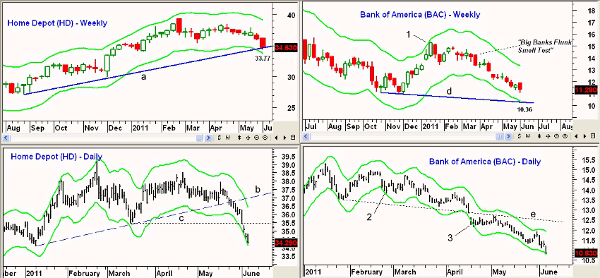
Chart Analysis: Home Depot (HD) was down almost 1% on Monday to close at $34.29, not far above the weekly Starc- band, which stands at $33.77. The weekly uptrend, line a, was tested last Friday.
- HD has additional weekly support from last fall in the $32 area
- For the past three days, HD has closed at the daily Starc- band, increasing the odds of a bounce in the next few days
- There is initial resistance at $35.50, line c, with the daily Starc+ band at $36.46. The former daily uptrend (line b) is at $36.98
Financial stocks have been leading the market on the downside, and Bank of America (BAC) closed Monday not far above weekly Starc- band at $10.36. BAC reached the 50% retracement resistance and the weekly Starc+ band in January (point 1). The relative performance, or RS analysis, deteriorated by March (see “Big Banks Flunk Smell Test”) and the technical outlook for BAC has stayed negative.
- The weekly chart also has trend line support, line d, in the $10.36 area
- BAC closed Monday on the daily Starc- bands. In February (point 2), the stock tested the Starc- band for three days before bouncing by almost a dollar
- In April (point 3), BAC tested the Starc- band for two days then moved sideways for two weeks before resuming its decline
- The daily Starc+ band is at $11.92 with strong trend line resistance (line e) in the $12.35 area
NEXT: More Oversold Dow Stocks; How to Profit
|pagebreak|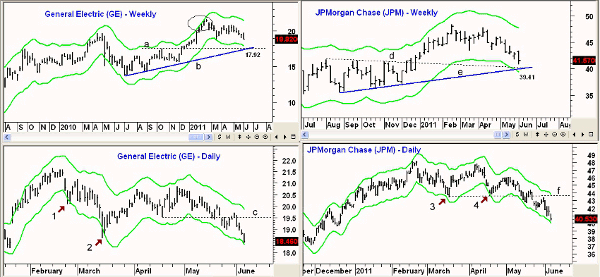
Click to Enlarge
General Electric (GE) tested its weekly Starc+ band for four consecutive weeks in February, reaching a high of $21.65. It closed Monday at $18.46, just above the daily Starc- band. This is a decline of 14.7% from the highs.
- The weekly Starc- band at $17.92 could easily be reached this week
- There is converging chart support (lines a and b) in the $17.50 area
- In February, GE closed below the Starc- band at point 1 before rebounding for three days
- GE traded well below the Starc- band in March and then began a several-week rebound that almost took GE back to the Starc+ band
- There is minor support for GE at $19 and then stronger support in the $19.50 area, line c. The daily Starc+ band is now at $19.85
Another well-known financial stock, JPMorgan Chase (JPM), is also on the most oversold list, as it closed Monday at $40.53, just 2.7% above the weekly Starc- band at $39.41.
- JPM has converging chart support at $39.90-$40.24, lines d and e, which may hold JPM above the weekly Starc- band
- JPM is now just barely above the daily Starc- band at $40.38
- In March, JPM came close to the Starc- band (point 3) for several days before rebounding 10%. A similar test in April, point 4, preceded a two-week rebound
- There is initial resistance for JPM at $42 with stronger resistance (line f) and the daily Starc+ band at $43.60
What It Means: It is important to understand the basic interpretation of the Starc bands. If prices are close to the Starc- band, it means that it is a high-risk time to sell and a low-risk time to buy. That does not mean one should just buy when a stock reaches the Starc- band, but it should be part of your evaluation process.
Similarly, when a stock is at the weekly Starc+ band, you should not automatically sell, but it does indicate that risk on the long side is high.
Often times a stock will continue to edge lower after testing the Starc- band, but it will generally not accelerate to the downside. Typically, when a stock closes at or below the Starc- band, it will rebound or at least move sideways for a few periods before the decline resumes.
For option traders employing a covered call strategy, buying the calls back that you have sold against existing stock position when the stock reaches the weekly Starc- band is a valid strategy. You will often get a good bounce where you can re-establish the covered call strategy. Put or call buyers can use the weekly Starc bands to help identify good entry levels.
How to Profit: Though the above four stocks can certainly decline further, the Starc band analysis suggests that they are likely to either stabilize at the weekly Starc- bands or rebound in the next few weeks.
The weekly volume analysis looks the best for Home Depot (HD) and suggests that the current decline will eventually present a buying opportunity.