
Market timing can be made complex or simple, says Greg Capra of Pristine Capital Holdings, Inc., and he has studied many methods and definitely found the simple approach the way to go.
Those studies were a quest for finding that method and what works for timing and what doesn't? What you'll find surprising is that the typical tools used by the majority do not work. I know you're interested in what does and I'll show you.
Before we review what to use, let's review some of the methods often talked about to determine market turns. Almost all of them will give a signal after a turn of some form has already happened. For example, the break of an uptrend trend line will signal a violation of the uptrend since prices have already moved lower. However, haven't you see uptrend lines broken that were followed by an almost immediate reversal back up in the direction of the trend? I have many times and found them inaccurate.
Let's think about the use of a trend line. An uptrend line is drawn by "connecting the dots" and is supposed to show you a support line that is projected into the future. If that line is violated, it signals the end of that uptrend. Why should that be the case though? Can you really locate significant reference points of support by drawing lines on a chart? How do you know you are connecting the right dots? And since there are different points that the line can be connected to, should you draw from all of them? And, what if those lines intersect, does that make for a more significant support point? And then, what if you change the time frame from a daily one to a weekly one? Doing that has now changed the "dots" to connect to. Are the lines in the weekly time frame more significant than those in the daily time frame? Getting complicated and confusing isn't it?
What about moving averages as a market timing guide? Okay, which one should be used? Is a break of the 50-day moving average a trend violation? How about the 100-day? Surely the break of the 200-day moving average would be bearish. However, by the time prices made it below the 200-day moving average, the trend would have been violated long ago.
There are also moving average crossovers. Again, which moving averages should be used? The 5-MA crossing the 20-MA is a popular combination. Then there is the "Golden Cross" of the 50-MA crossing the 200-MA. Golden cross sounds impressive. Then of course, there is the question of what type of moving average to use. Simple, exponential, weighted, and there are others, even optimized. The combinations are endless.
Click
to Enlarge
NEXT PAGE: How to Determine Market Turns|pagebreak|
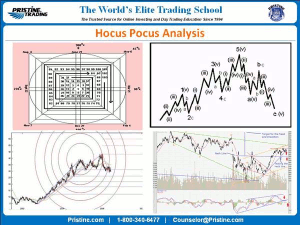
If you have asked yourself these questions in an attempt to figure out a method of timing the market's turns, you're not alone. I suggest that you forget these types analysis and others revolving around price indicators. They are useless for market timing. If you're thinking we need the more esoteric types of analysis like Gann lines, Gann Square of Nine, Elliott Waves, Any Waves, Fibonacci Lines, Cycles or planetary alignments you can be relieved. We want no part of that hocus pocus type of analysis.
What you need to use for market timing are market internal gauges based on market breadth and traders' sentiment. Data to measure breadth consists of stocks making new highs and lows, advancing and declining stocks, the volume in advancing and declining stocks. These can even be combined with formulas that use that data.
These are excellent ways of determining the odds of a market turn, since they give us a clear measurement of when they reached an historical extreme. In other words, they tell us when the broader markets have moved too far in one direction or the other based on what has actually happened compared to the past years. They also warn us before the turn. We don't have to use all of these breadth gauges and are going to keep this simple.
You may think prices have moved too far, but how many times have prices continued to move much further than you thought they could. Or you thought that prices would move further only to see them reverse. Breadth gauges provide an objective measurement based on the history of the broader market's internal movement, not the recent price movement of one index.
Sentiment gauges tell us how traders, investors and institutions "feel" about the markets. Are they too bullish, too bearish, or too complacent? Sentiment surveys, put/call ratios, and volatility indexes are excellent tools for measuring the current sentiment against the historical extremes.
This letter cannot cover all the breadth and sentiment gauges available, but what I will show you are a few things that can be found at free websites or in your charting program. They are also easy to use and understand.
Click
to Enlarge
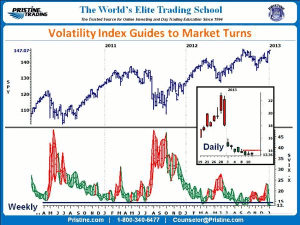
The volatility index (VIX) is a measurement of anticipated future volatility in the market. Extreme highs are associated with market lows and extreme lows are associated with market highs. In other words, the volatility index moves inverse to the market. A move to support in the VIX is short-term bearish and a move to resistance is short-term bullish. I say short-term because a significant turning point would require other information that the VIX cannot provide. Pristine Tip: short-term market timing requires a combination of breadth and sentiment gauges.
NEXT PAGE: Useful Breadth & Sentiment Gauges|pagebreak|
Currently, the VIX is at a low point where it has turned up from over the last few years. This is not near an all-time low, so the VIX could move lower or sideways. Over the last few trading sessions, the VIX has been holding this area and the daily ranges have been narrow. This type of price action in the VIX has historically preceded a short-term move up. Set an alert at 14.00. A move above would be a short-term bearish confirmation.
Click
to Enlarge
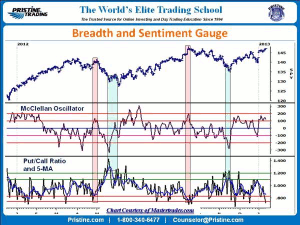
In the above chart is the S&P 500 ETF (SPY), the McClellan oscillator, and the equity put/call ratio with a five-period moving average of that ratio. The McClellan oscillator is simply the difference between the moving averages of the daily fluctuations of advancing stocks minus declining stocks. Historically, when the oscillator moves to between plus or minus 100 and 200 a short-term reversal is likely. However just like the VIX, we won't rely on the McClellan oscillator alone for a signal. At times, extremes are actually confirmation of a move to trade with, not against it.
The equity put/call ratio tells us how many puts are being bought (bearish bets) versus calls (bullish bets). The ratio moves up when more puts are being bought than calls and down when more calls are being bought than puts. The day-to-day movement can be very erratic and may not mean much. However, when the ratio moves to an extreme, we want to take note of it. When the five-period moving average of the ratio is at an extreme as well, it is a much stronger indication of a short-term turn. Again, we will not rely solely on the putt/call ratio.
What we are very interested in is when there is an extreme in put buying (bearish sentiment) at the same time there is an extreme in stock selling (bearish breadth). This would signal a market low (green area). We are also interested to know when there is an excessive amount of call buying (bullish sentiment) with an excessive amount of stock buying (bullish breadth). This would signal a market high (red area).
Currently, The McClellan oscillator is into a short-term bearish extreme and the put/call ratio moved to a bearish extreme last week; however, the 5-MA of the put/call ratio has not reached an extreme yet. This is telling us that risk for longs is rising short-term based on the gauges covered, but without the 5-MA at an extreme of call buying, there is still the potential for higher prices. Any market move to higher prices should get option traders "all-in" and the odds of a pullback in the market would increase based on our gauges.
There you have a simple method for market timing. Is it 100%? Of course not, but it is good, simple, and easy to understand. I know it will serve you well over the years as it has for me.
By Greg Capra, President & CEO, Pristine Capital Holdings, Inc.