
With over 1,400 exchange traded products on the market, it’s no surprise that tactical investors and savvy traders have embraced them for their ease-of-use, transparency, and unparalleled liquidity, writes Cory Mitchell of ETFdb.com and VantagePointTrading.com.
ETFs have rightfully earned the approval of countless buy-and-hold investors as these financial vehicles have proven to be cost-efficient portfolio building blocks. As such, ETFs can do a lot more than offer diversified exposure; these funds can be effective in executing both simple and more sophisticated hedging strategies, helping to improve your portfolio’s risk-adjusted returns.
ETF Hedging Advantages
Hedging is using one investment to help offset the risk of another. This strategy, when done properly, can greatly reduce the susceptibility to market fluctuations and adverse price moves. In order for a hedge to work, the “hedged” assets should move in different directions—when one falls, the other rises—netting out the fluctuation. Such strategies are effective when investors are unsure of the direction of the market, but don’t want to sell their portfolio, or when they wish to reduce the overall risk of their portfolio.
ETPs trade like stocks, but mimic the movements of all sorts of asset classes, sectors, indexes and strategies, making them ideal candidates for hedging. ETPs are cost-effective as there are no “load” fees (common in mutual funds) and stock exchange liquidity provides an easy way to enter and exit positions.
Asset Class Hedging
Building a diversified portfolio without the use of ETFs can be problematic for small investors. ETPs provide access to multiple assets and asset classes, which can be combined to create a more balanced portfolio.
For example, if you already own a portfolio of single stocks, you can easily buy a bond ETF such as Barclays 20 Year Treasury Bond Fund (TLT) or the iBoxx $ Investment Grade Corporate Bond Fund (LQD) to add bond exposure.
Bonds and stocks move together at times, so several commodity ETFs, or a single diversified-commodity ETF, can further hedge against adverse moves in a portfolio. DB Commodity Index Tracking Fund (DBC) reflects the average movement of 14 of the mostly heavily-traded global commodities, DB Agricultural Fund (DBA) tracks the most widely-traded agricultural commodities; both funds provide significant exposure to commodity markets with one transaction.
Figure 1 shows the percentage price movements of the SPDR S&P 500 (SPY)—which reflects stock performance—as well as TLT and DBA. While at times they move together, over a two-year period they work to balance each other out; holding all three results in fewer significant fluctuations than holding only one.
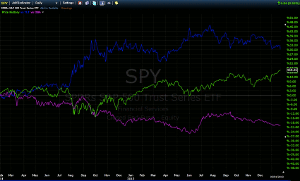
Figure 1. SPY (green) vs. TLT (blue) vs. DBA (pink): Daily Chart – Percentage Scale Strategy
Click to Enlarge
Stock Hedging
Hedging a specific stock position has become a lot easier with the advent of “sector ETFs.” Stocks are categorized into sectors, and each sector now has a highly liquid ETF that tracks its performance. Use these ETFs to hedge stock positions within your portfolio.
Assume you have a significant position in Apple (AAPL), Google (GOOG), or Cisco Systems (CSCO), or any other technology sector stock. If you still like the stock and don’t want to sell it, but you’re worried about a short-term pullback (or just want to reduce the volatility of the position) short-sell or buy put options on the Technology Select Sector SPDR (XLK). If your tech stock declines, it is quite likely the sector ETF will also decline, making you money on your short position and offsetting the loss on your long stock position.
The strategy can be applied to nearly any stock that has some correlation with its sector, as there is a sector ETF that tracks almost every stock: see the complete Sector ETF List.
Even though a stock is part of a sector, it may not always move with the sector. In this case, the “long stock-short ETF” strategy may not effectively hedge the position.
NEXT PAGE: Inflation & Currency Hedging
|pagebreak|Inflation Hedging
Inflation is a cause for concern among investors; it dwindles their buying power, and their stock returns may not compensate them for it. Since inflation is an increase in prices, many commodities appreciate during inflationary times. Therefore, investors can buy commodities as a hedge against inflation—the rise in commodity prices is likely to fully or partially offset the loss in buyer power. Research by AllianceBerstein indicates “published spot commodity prices date back at least to the 1800s and confirm that on average, commodity prices appreciate in line with broad inflation measures.”
Precious metals are a common selection, and the SPDR Gold Shares (GLD) and iShares Silver Trust (SLV) give investors easy access to the commodities. An alternative is the DB Base Metals Fund (DBB), which provides exposure to copper, zinc, and aluminum, all widely used in various industries. The fund is likely to rise under inflationary pressures, with a decline signifying little inflation pressure.
Investors can also short a bond fund in an attempt to compensate for inflation. Bond prices fall as interest rates and inflation rises; therefore, shorting a fund such as the Core Total US Bond Market ETF (AGG) can compensate investors when inflation begins to rise aggressively.
Buying the Barclays TIPS Bond Fund (TIP) can also offset inflation, as the fund is designed to protect investors from inflation. TIP invests in Treasuries that rise and fall with the Consumer Price Index (CPI). Since Treasuries pay less interest than traditional corporate bonds, the fund is likely to act as a partial hedge, and not entirely compensate investors for the rise in real prices (inflation) they are experiencing.
Currency Hedging
Currency exposure can also be hedged using ETFs. Non-US investments (or an investment outside of your own home currency) create an additional element of risk: currency fluctuations.
Assume you’re a US investor and buy a stock listed in Canada; your stock return is not only determined by the performance of the stock, but also the performance of the USD/CAD currency exchange rate. If the US dollar (USD) appreciates it will hurt your stock return, since when you convert your proceeds from the Canadian stock back into US dollars, you will need to pay more for those US dollars.
If the USD depreciates, it helps your stock return—either to offset the capital losses or add to the capital gain of the stock. Therefore a hedge is really only needed to compensate you (hedge) for a rally in the USD; if you think your foreign currency will appreciate (USD depreciates), it makes sense to avoid hedging.
When you buy a foreign asset, you’re buying that foreign currency as well, and selling US dollars. Therefore, you need to buy an equivalent amount of USD—which can be done through an ETF—to help net out the foreign currency fluctuation. In this case, you could short-sell the CurrencyShares Canadian Dollar Trust (FXC), which means you are effectively selling your Canadian dollar exposure, and buying your USD back.
A more general strategy is to buy the DB USD Index Bullish (UUP), which simulates being long USD future contracts versus a basket of currencies; this is effective if you have multiple assets in different currencies around the globe and want to hedge with one transaction.
Currency ETFs are available for commonly traded currencies: see non-leverage currency ETFs.
The Bottom Line
In addition to serving as portfolio building blocks, ETFs are effective hedging vehicles for those looking to tame volatility, guard against inflation, net out foreign currency risk or simply take advantage of a timely opportunity in the market.
By Cory Mitchell, Contributor, ETFdb.com, and Founder, VantagePointTrading.com