

The VIX has provided us with some great trading profits over the past six months, but volatility linked exchange-traded products remain a risky venture, writes the Chad Karnes at ETFGuide.com, so he prefers using VIX options to hedge rather than hit-and-miss ETPs.
Given the VIX's recent decline to six-year lows, and potential profit setups that now abound, it is time to revisit some of the key things to know in trading volatility.
Recently I wrote an article about a potential VIX trade setup that is playing out right now. The VIX has helped us spot short-term market tops in the past, providing great volatility trade setups that can be taken advantage of using traditional options or the newer VIX exchange-traded products (ETPs).
But there are some nuances in trading the VIX that need to be addressed before jumping into a volatility investment. Some of them are good, some are bad, and some are really ugly.
The Good
One great aspect of trading the VIX is there are a lot of different ways to
capitalize on potential opportunities for investors, traders, and hedgers
alike.
- The Fear Trade - You could trade the S&P 500 (SPX) based on the VIX signals. Typically the VIX will behave inversely to the S&P 500. When the VIX is up, the SPDR S&P 500 Trust (SPY) is usually down, and vice versa. But this is not always the case. There are examples when both the VIX and the markets are up or down together. A majority of the time, though, especially on days with big market moves, they move in opposite directions. This is the reason the VIX is often referred to as the fear trade, as it typically rises when markets sell off.
- More Traditional - You can take advantage the old-fashioned way and use futures or option strategies such as straddles or delta neutral spreads. This would likely provide the most correlated trade with volatility and allow for direct, measurable, and fine-tuned strategies. Futures and options are usually considered risky, can be convoluted, and are definitely not for all investors, though. This strategy would likely work best for a longer-term sophisticated investor looking to hedge his or her portfolio.
- Adaptation - The best part about the VIX today is that there are numerous ETPs that track volatility and allow individual investors to take advantage or hedge moves in future volatility expectations. But they all also come with a lot of baggage that can kill an investment if they are not properly understood or executed.
A Plethora of Volatility ETPs
Each year, there are more
and more volatility ETPs being added and today there are over 15 different
choices. The major differences between them all typically involve which
exchanges they trade on, which banks control their underlying assets, their fund
structures, and the amount of leverage utilized in their tracking.
For instance the ProShares VIX Short-Term Futures ETF (VIXY) is an unlevered ETF that attempts to track the short-term (one month) VIX by investing in VIX futures. In contrast, the Horizons BetaPro S&P 500 VIX Short Term Futures Bull Plus ETF (HVU) is a 2x levered ETF that trades on the Toronto Stock Exchange and also invests in VIX futures. A very similar US exchange version is the ProShares Ultra VIX Short-Term Futures ETF (UVXY).
NEXT PAGE: The Bad & Ugly
|pagebreak|The Bad
The bad thing about all of these ETPs is they
don't track the popular underlying VIX Index (VIX)
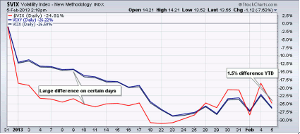
all that well. The chart below shows two of the popular VIX ETFs, the VIXY and
the VelocityShares VIX Short Term ETN (VIIX).
Since the beginning of 2013, the tracking error is showing a 1.5% difference
through February 5.
The VIXY and VIIX behave basically identical, but they don't do the best job of tracking the VIX Index's movements and are around 1.5% behind for the year.
Click
to Enlarge
Over short periods of time, the volatility ETPs perform similarly to the VIX (in red), but there will be hiccups along the way when one will rise or fall faster than the other (like at the beginning of the year when the VIX underperformed compared to more recently when the VIX has outperformed).
Unfortunately this seems like something that traders of volatility ETPs will have to accept over the short run, until a better alternative is created.
The Ugly
A 1.5% tracking error over the course of a few
weeks may be acceptable given the kind of volatility the VIX index has, but that
amount increases greatly as time goes on.
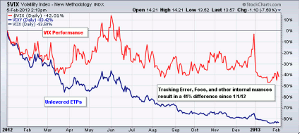
Since the beginning of 2012, the difference between the ETPs, after fees and other nuances associated with their inner workings and structure, compared to the VIX is a huge 41%. The VIX is down 42% since the beginning of 2012, but the ETPs that supposedly track the front month volatility (VIX) are down a whopping 83% since then.
That is unacceptable and a major warning for investors to not hold
these products longer than a few weeks. The chart below puts the tracking error
and fee deterioration into perspective.
Click
to Enlarge
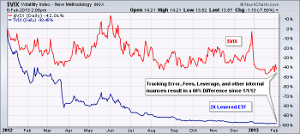
The levered VIX products, just like the other levered ETPs available to investors, also have the well known "time decay issue" to add to their tracking error. The below chart of the VelocityShares Daily 2x VIX ST ETN (TVIX) puts the tracking error and time decay into perspective with an even larger 60% difference since the beginning of 2012.
Click
to Enlarge
The VIX can be helpful in spotting market turning points through its inherent complacency and fear measures of the market. But, in order to trade volatility specifically through ETPs, an investor must be nimble and willing to accept short-term hiccups and imperfect tracking.
For volatility trading, my firm prefers the purer option play as we suggested on December 17, 2012 when the VIX was bottoming at 16. It was again a great time to buy protection. "The VIX has refused to spend much time below the 15 level providing a solid support and buying area for VIX bulls. As it approaches that level, buying front month in-the-money calls is a good trade. We like going long the VIX Jan 14 call options at $271 per contract."
Two weeks later, the VIX was over 20 and those options were up over 100%, trading for $560 where profits were taken as the technicals warned us of a short-term top.
The VIX ETPs can be used to trade volatility over short periods of time (a few weeks max), but they should not be held any longer. They are made strictly for trading and not for longer-term portfolio holdings or hedging. Options remain the better way to hedge your portfolio with volatility protection.
By Chad Karnes of ETFGuide.com