
Today, Russ Allen, instructor at Online Trading Academy writes about what the option chain can tell us about whether trading a particular option might be too costly, in the sense that the “markup” on it is too high.
We know that the buyers of options acquire rights to purchase or to sell an underlying asset (which I’ll call “the stock”) on or before a certain date, and at a certain price. At any given moment, a single stock may have hundreds or even thousands of separate option contracts available. For example, on Oct. 23, Apple stock closed at $645.74. We could buy options on the stock of Apple that expire at any of ten separate dates in the future, from two days to 821 days out. The strike price of available options ranges from $195 per share to $1040. The options themselves range in price from one cent per share to over $450 per share. Altogether, approximately 3,000 distinct option contracts are available on Apple alone.
Although many of these 3,000 distinct contracts have never sold a single lot, there are posted prices (bid and ask) for every one of them. Whose prices are these?
The answer is that some of these bids and offers are orders placed by retail traders like us; some of them are orders from money managers and other institutions; but the vast majority are prices posted by options market makers. The market makers are option dealers. Their business is literally to buy options wholesale and sell them retail. Their markup or profit margin is the difference between the bid and the ask.
Notice in Figure 1 that on Oct. 23, the Nov ’12 calls at the $640 strike have a bid of $27.50 and an ask of $27.70. These quotes are per share. A single one of these contracts, which involves 100 shares, could be bought on that day from the market makers for $2,770, or sold to them for $2,750. The $20 per contract difference between the bid and ask is the market maker’s profit margin.
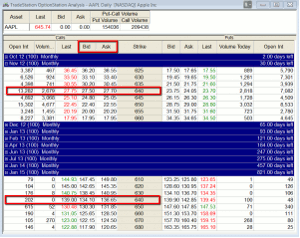
Figure 1–a Minimal Option Chain
Click
to Enlarge
The amount of this margin—that is, the size of the bid/ask spread—varies based on several things, the main one being competition. If there are many traders actively buying and selling a particular contract, then the market makers will not be able to maintain wide spreads. If they try, other traders will bid more than the market makers are willing to pay, and sell for less than they are willing to sell for, thus squeezing out the spread. Conversely, if the market maker is “the only game in town,” they are free to post a wide spread, and to get large profits on those few contracts that they do buy or sell. So a lot of competition is a good thing for everyone except market makers.
NEXT PAGE: Things to Look Out For
|pagebreak|Extending this example, note in the lower part of Figure 1 that the January 2015 calls at the same $640 strike are shown with a bid of $134.10 and an ask of $136.65. Here, the spread is not just $.20 per share, as it is on the November 2012’s, but $2.55. Even as a percentage, the spread is more than twice as much as it is for the November 640’s. How can this be?
We can see the answer by looking at the open interest and volume numbers for these two options. In this example, the November 2012 640’s traded 2,679 contracts on Oct. 23; the Jan 2015 640’s traded none. Zero. So if anyone had wanted to buy or sell the Jan ’15 640 calls on Oct. 23, they would have had only the market makers to deal with, and the market makers could name their price. That’s why we generally want to trade only options with relatively large volume. Those are the ones where the market makers are “kept honest” by having to compete with other buyers and sellers. In our professional options class, we recommend that traders deal only with options that trade in the hundreds of contracts per day.
Which options are likely to trade with this kind of volume? The following general rules apply:
- Options nearer to expiration have larger volume than options that expire farther out in time.
- Options with strike prices close to the current underlying price have larger volume than options with strikes that are far out of the money or far in the money.
- Options on stocks that are themselves very liquid are more likely to have high volume.
The volume columns in this option chain are next to columns labeled open interest. What is the difference between open interest and volume? Volume is the simple count of the number of contracts that changed hands in a period of time. Open interest is the total number of contracts that are outstanding at a given moment. Looking at Figure 1 again, the Jan 2015 640 calls have an open interest of 202 contracts, and a volume of zero. That means that at the end of the day on Oct. 22, 202 of these contracts had been sold, and were still outstanding. No contracts were traded on Oct. 23, so that same number, 202 remains the open interest to start off Oct. 24. Now is where it gets more interesting.
Let’s say I decide to sell a Jan ‘15 640 call on Oct. 24. I click the button on my trading platform labeled “Sell to Open,” and my order is filled. That’s the only transaction that happens in these calls all day. What will happen to volume and open interest?
The volume question is straightforward. For Oct. 24, the volume column will show a value of 1 for the one contract that I sold.
How will the open Interest change? That depends. It may stay the same (202); or it may increase by one contract, to 203, depending on the previous situation of the person to whom I sold it.
By Russ Allen, Instructor, Online Trading Academy