
As 2012 rapidly comes to a close, a lot of investors and traders focus their attention on tax matters. Alan Ellman of TheBlueCollarInvestor.com details a tax-efficient option strategy for stocks that you may want to keep.
For covered call writers, the main stock option strategy is to purchase an equity specifically for the purpose of selling the corresponding call option. The investment time frame is one to two months as earnings reports will end the "run" of even the best performing equities (if you agree with my guidelines). In many cases, share assignment is permitted by the seller and even if early assignment occurs, our investment would still have been a successful one. In other words, losing (selling) the stock is no problem and really just part of the strategy.
There are other investors who sell call options in a different manner, called portfolio overwriting. In this instance, a call option is sold on a stock already part of an existing portfolio. That option is selected in a manner where it is NOT expected to be exercised. Remember that you need to own 100 shares for every options contract sold.
Why a Portfolio Overwriter Does Not Want His Shares Assigned
This
is basically a tax issue. The holding period for short-term versus long-term
capital gains is one year. If the stock has been held for less than that time
frame, the writer would prefer to retain the equity for a longer time frame. In
addition, if the shares have appreciated substantially from the cost basis,
selling in any time frame may not be in the investor's best interest.
Another Important Tax Issue
If the underlying stock has
not accumulated the full one-year holding period for long-term capital gains,
covered call writing may suspend or eliminate the current accumulated holding
period. It is advisable to consult with your tax advisor on this matter.
Advantages of Portfolio Overwriting
- Achieve higher returns in declining, neutral, and slightly bullish
markets
- Beat the returns of long-term holders of equities
- Increase portfolio downside protection, thereby minimizing risk
- Generate a monthly cash flow
- Use option profits to compound your money
Strike Selection for Portfolio Overwriting
Since our
goals are to generate a monthly cash flow and NOT have our shares
assigned, common sense dictates that we sell out-of-the-money strikes. This will
benefit us in that time decay is greatest for these strikes and option value
will dissipate as we get closer to expiration Friday. Remember, we don't want
our option strike price ending up in-the-money (lower than current market value
of the stock).
NEXT PAGE: More Strategy Details
|pagebreak|Our mindset needs to be slightly different when selling these OTM strikes in that a 2-4%, one-month return is too lofty a goal. I would set it more at 1-1 1/2% per month, ensuring that the implied volatility of the option is not too high. A high IV means that the market is anticipating a large price movement and that increases the possibility of the option ending up ITM. So settle for a lower premium and therefore less chance of assignment.
As a guideline, I like to see the share price at least 5% lower than the strike sold. As an example, if I sold a $50 strike, I would want that equity to be currently trading @ $47.50 or less, with the option premium generating 1 to 1 1/2% for the month. Let's look at the options chain below for GMCR, one of the stocks often found on our premium watch list:
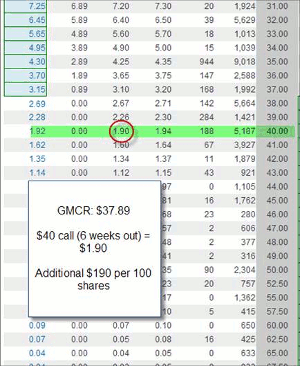
GMCR: options chain
Click to Enlarge
If the share price remains below $40 by expiration Friday (the third Friday of the month), no action is needed on your part and you're free to sell another option the next month. If the share price is above the strike price ($40), you can roll the option (buy it back and sell the next month option). If you need cash to buy back the options and don't have it in your account, you can sell enough shares to buy back the options and retain a majority of the original shares. In keeping with our cash allocation and portfolio rebalancing requirements we would tend to sell shares that have appreciated the most and have a dominant position in our portfolio.
Why Some Portfolio Overwriters Sell ITM Strikes
This is
a riskier strategy if keeping the stock is important to the investor, but there
is a case that can be made for it. It is generally used when the stock or
market, in general, is declining and the ITM strikes will generate greater
returns with more protection. Also, the higher delta of the option (amount the
option changes with a corresponding $1 change in the stock price) will make it
easier to close or roll the position (buy back the option). Investors also use
the ITM approach in conjunction with technical analysis where support and
resistance points are identified and ITM strikes are sold at resistance and
closed or rolled if still ITM near expiration Friday.
What If Early Assignment Occurs?
This will not occur
often, but it could eventually happen. In these cases, purchase an amount of
shares equal to the obligation to deliver and notify your broker that these
newly acquired shares should be indentified as the shares delivered to meet the
option obligation. Check with your broker, before the fact, as to the best way
to manage such scenarios.
Conclusion:
Portfolio overwriting provides many of the
advantages of the buy-write strategy, but because of tax implications, income
goals, and strike management differ and need to be fully understood before
taking action.
By Alan Ellman of TheBlueCollarInvestor.com