
New technologies have certainly created a boom in the US oil and exploration and production sector, but the federal government never lets an opportunity go unregulated...and that is slowing down what's happening on tribal and public lands, writes Don Groves at Casey Research.
On May 11, the US Bureau of Land Management (BLM) published proposed regulations governing "Oil and Gas; Well Stimulation, Including Hydraulic Fracturing, on Federal and Indian Lands."
BLM is a latecomer to this party. Its belated meddling lacks practical or economic justification. Instead, the proposed BLM rule would drive oil and gas developers off federal and tribal lands.
Complying with the rules is too complicated and costly. Producers can realize a much faster and much better return on their capital investment by developing oil and gas reserves on adjoining private lands.
Federal and tribal lands hold large reserves of oil and natural gas. At a time when the United States desperately needs to move toward, not away from, energy independence, it makes no sense to let bureaucratic meddling effectively place these valuable domestic reserves out of reach. The problems with BLM's approach are myriad.
BLM Misses the Mark
First, a central, federal, one-size-fits-all approach does not work. The reserves that the oil and gas industry wants to access using hydraulic fracturing occur in areas with different geographic, topographic, hydrological, population, precipitation, and umpteen other characteristics.
The oil and gas deposits are found at different depths; the water table is at different depths. The surface and subsurface vary dramatically, ranging from the Marcellus Shale Formation in the Northeast to the San Juan Basin in the Southwest.
States and tribes have long ago stepped up to the plate with sensible regulations suitable to their individual conditions. They are way ahead of BLM.
Second, even if states and tribes did not already have this under control, BLM's proposed regulations are inappropriate. The BLM regs are based on inaccurate assumptions, flawed economics, and a perceived but actually nonexistent need.
"It is assumed" (by BLM for its base case) "that a certain number of well stimulation events may result in contamination and thus pose a cost to society." This is the foundation of the agency's flawed estimation of "social benefits" ranging from $11.7 million to $50.3 million per year. We are left to guess what those social benefits might be.
Despite hysteria about fracking causing earthquakes, contaminating aquifers, and sending explosive gases to kitchen sink faucets, there is actually no evidence that fracking causes such problems. Indeed, the Association of American State Geologists (AASG) "recognizes that the environmental record of hydraulic fracturing activities over the past 60 years has been overwhelmingly positive."
Probably the most frequent indictment of fracturing is its potential contamination of drinking water. But the AASG further notes that "geologic data generally show a significant vertical separation between most oil and natural gas reservoirs targeted for hydraulic fracturing and the shallower freshwater aquifers." In other words, fresh water is not typically found anywhere near the fracturing area.
BLM acknowledges that about 3,400 wells—roughly 90% of all wells drilled on federal and Indian lands each year—use hydraulic fracturing. But it offers no evidence of groundwater contamination as a result of that fracking.
As noted by Donovan Schafer in his excellent article, Frack Attack: "Freshwater sources can, in fact, be contaminated by oil and gas activity. However, the contamination is not a result of the actual fracking process. Instead, it is caused by poor drilling practices and surface spills."
Even Matt Watson, an energy-policy specialist with the Environmental Defense Fund, acknowledged that "the term 'fracking' is being used for all the things in the process that can cause problems. Most of those problems have nothing to do with the actual fracking."
|pagebreak|Elizabeth Ames Jones, chairwoman of the Railroad Commission of Texas, testifying before the US House Committee on Science, Space, and Technology, said: "For fracturing fluid or the natural gas or oil to affect the water table in Texas, those substances would have to migrate upwards [through] thousands of feet of rock, sometimes even miles. It is simply geologically impossible.
"The stories of environmental damage or contaminated drinking water from hydraulic fracturing are simply untrue. You have a better chance, frankly, of hitting the moon with a Roman candle than fracturing into freshwater zones by hydraulic fracturing shale rock."
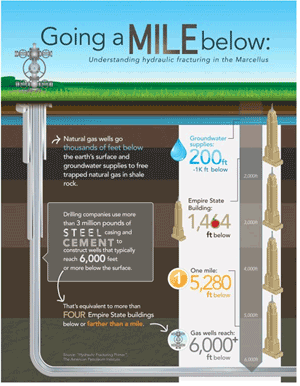
That comes as no surprise, since fracking fissures tend to radiate horizontally, not upward. Even if they did radiate upward, those thousands of feet of multiple layers would blunt their progress long before they got anywhere near fresh water. This illustration shows how far the Underground Source of Drinking Water ("$W") is from fracking operations.
Click
to Enlarge
Prohibitive Costs
BLM badly underestimates the cost of compliance with its proposed rule. Oil and gas developers already face costly delays in obtaining BLM approval of Applications for Permits to Drill (APDs).
The cost of gathering, compiling, and submitting the additional information BLM now wants is real, substantial, and not realistically tied to any benefits. Operators already submit information on wellbore integrity, casing, and cementing programs to the agency through the existing APD process. The BLM rule adds ten more categories of information to be supplied.
BLM is already limited by a shortage of staff having necessary expertise. The proposed rule would compound delays and the resulting expense as BLM struggles to deal with added responsibilities. I am reminded of the sensible admonition: "Never holler 'Whoa!' at a horse race."
|pagebreak|The delays imposed by BLM's unnecessary "cement bond log requirement," for example, complicated by its more stringent requirement to isolate "useable" rather than "fresh" water, will mean that drilling rigs will sit idle at a cost of over $20,000 per day. Let me explain.
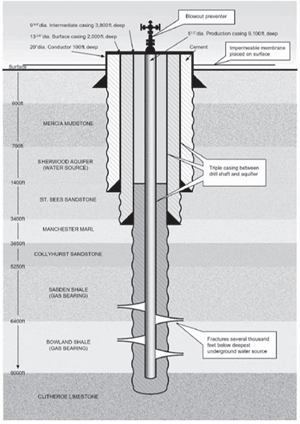
The following illustration shows a typical configuration of nested well casings, each cemented within the wellbore, passing through the Sherwood aquifer in the UK. As you can see, the fresh water in the aquifer is thousands of feet above the fractures.
Click
to Enlarge
BLM has dropped its definition of "fresh water," however, and now proposes that producers also protect "useable water" (found at much greater depths) with cemented surface casings.
"Usable water" includes water that is in fact not "usable" at all—water containing up to 10,000 parts per million (ppm) of total dissolved solids (TDS). For comparison, EPA's drinking water standard for humans is only 500 ppm TDS. The cost of extracting and treating supposedly "usable" water (that is actually heavily laden with dissolved solids like salt and sulfate) far exceeds the value of any practical usage.
Furthermore, to protect that "usable" water, drillers would need to extend the surface casings thousands of feet deeper. Then, to comply with the cement bond log requirements, they would need to wait for the cement to fully cure, run the sonic probe, produce the cement bond log, submit it to an inadequately staffed BLM, and wait 30 days for approval.
The time costs would be prohibitive. Drilling rigs can't just sit idle waiting for these preliminaries to be finalized. Instead, they will be decommissioned and moved elsewhere at great expense—greater expense than can be justified. These costs are completely overlooked by BLM. Faced with such costs of developing oil and gas on federal and Indian lands, operators will go elsewhere.
|pagebreak|Indian Country Speaks Out
BLM is just "occupying the field," making sure it has a hand in this rapidly growing industry, but without regard to the unintended consequences of its actions. BLM's proposed fracking rule would result in reduced domestic oil and gas production generally, and a reduction in revenues from federal and Indian lands.
Indian tribes would be particularly hard hit. The United States government has a solemn, longstanding trust duty to American Indian tribes. That includes BLM. These actions by the tribes' federal trustee wreak havoc with the tribes' opportunities to earn badly needed oil and gas revenues from their reservations.
The federal government also has a trust duty to American taxpayers as the custodian of our public lands. American taxpayers, the true owners of federal lands and beneficiaries of federal land management, are probably not as acutely aware, as are tribes, of the irresponsible actions of their trustee.
Meanwhile, the predicament of both tribes and taxpayers is worsened as wells drilled on neighboring private lands drain common reservoirs. A similar situation is happening off the Florida Keys, where our own domestic oil and gas industry is barred from drilling, while foreign operators—as guests of Cuba and with fewer environmental constraints—are free to suck common reservoirs dry.
I recently attended a meeting at the White House with representatives of oil- and gas-producing Indian tribes, at which they urged Obama administration officials to withdraw the proposed BLM fracking rule.
Dan Utech, deputy director for Energy and Climate Change on the White House Domestic Policy Council, stated that President Obama's "All of the Above" energy strategy calls for responsible development of oil and gas resources, as stated in his State of the Union address and in later speeches. Dan said it was important to pursue fracking prospects responsibly, and acknowledged that BLM may have taken a "crooked path" toward that objective.
The tribal representatives—seasoned veterans of the real world of oil and gas production—explained why BLM's proposed rule failed to advance that objective. They asked what pitfall BLM is seeking to address. They discussed cement bond logs as an example of how the BLM rule imposes a huge economic burden that is not justified by any corresponding benefits, and without correcting any contamination problem.
The tribal representatives took issue with BLM's shift from protecting not just fresh water but all "usable" water from drilling. Operators normally extend surface casings down to a depth of 1,500 to 2,000 feet—way more than enough to protect "fresh water."
|pagebreak|Running the surface casing to the depth of all "usable water" would mean extending the surface casing thousands of feet deeper. These new requirements push tribal oil and gas, and oil and gas on federal lands, out of the market.
Dan Utech said that the concern about BLM approval delays was at the top of their list, and that others from the drilling industry had already brought it to the attention of Obama administration officials. He said, "We want to be damn sure we get this right and take the time to do it right."
He did not identify the pitfall the rule was designed to address nor explain what the rule was a remedy for, despite requests that he do so. Nor did he consider the possibility that the "right" role for BLM might be doing nothing at all.
During mark-up of House Bill 3973, the Native American Energy Act, Don Young, chairman of the House Natural Resources Committee's Subcommittee on Indian and Alaska Native Affairs, successfully passed an amendment that would prohibit the BLM rule from applying to Indian lands unless the Indian land owner gives express consent.
Young said: "With their new fracking rule, the Obama administration is doing a real disservice to America's tribes. By giving Indian tribes the option to follow this new rule, my amendment simply increases tribal control over their lands and eliminates this new layer of bureaucratic red tape."
Although not discussed at the meeting, Congressman Bill Flores (R-TX) has separately introduced HR 6235, "a bill to delay action on the proposed rule regarding well stimulation on federal and Indian lands until such date as the secretary of the Interior submits a report examining certain effects of such rule." HR 6235 was referred to the House Natural Resources Committee.
Just Say No
I would summarize the message from Indian Country as this: the Obama administration needs to call off its dogs. Tribes are already quite sophisticated with respect to oil and gas development, including fracking.
Preferably BLM should withdraw its rule and simply leave tribes alone. By inserting itself at this stage, BLM is just delaying tribal energy development to the detriment of tribes without corresponding benefit.
Tribal representatives emphasized that the BLM rule is a solution in search of a problem. They said there has not been one incident of groundwater contamination as a result of fracking. They emphasized that Indian lands are not public lands.
Perhaps most important, the proposed BLM rule and the method by which it has been promulgated so far lacks respect for tribal sovereignty and authority. Fortunately, nothing in federal statutes requires subjecting tribal lands to the same standards as federal lands where tribes are capable of managing such matters themselves. In fact, the Indian Mineral Development Act protects the right of energy-producing tribes to develop their mineral resources as they deem appropriate.
Moreover, federal Indian mineral leasing regulations may be superseded by tribes. Tribes could simply exempt themselves from these proposed BLM regulations unilaterally.
Tribes may be able to squirm out from under the heavy, dead hand of this federal agency. The American taxpayers, however, still get screwed. There is little question as to whether BLM has jurisdiction over public lands.
So what does all this mean for oil and gas exploration and development enterprises? If BLM does not back off, developing oil and gas resources on public lands may be more trouble than it's worth. Developers may be able to work with Indian tribes, however, to develop oil and gas resources on reservations without having to deal with BLM.
None of the Above
The Obama administration's energy policy is ostensibly "all of the above." That is supposed to mean that, in the interest of energy independence, the administration supports and encourages development of all forms of energy.
Of course, we know that is simply not true. The administration has engaged in a blatant war on coal, has blocked onshore leases on public lands, has restricted offshore drilling and has blocked the Keystone XL pipeline. The Obama energy policy would more accurately be described as "none of the above," at least with respect to fossil fuels.
This no-fossil-fuels policy makes no sense. It is a disservice to all Americans who rely on readily available, affordable energy. It is a further disservice in that it hogties an entire sector of the economy, resulting in lost jobs and the reduction of otherwise available federal and tribal revenue.
No doubt about it: between increasing economic uncertainties and political meddling worldwide, energy investors have their work cut out for them. However, now is precisely the time to get in on the most promising plays, in order to ride the coming "super bull" in energy.
Read more from Casey Research here...
Related Reading:
This Election Could Be Bigger Than Ours