
To be successful, forex traders need to be sure their strategy fits the current market conditions, writes James Stanley of DailyFX.com, reviewing the qualities and key considerations when trading a range, trend, or breakout.
Before we build a strategy, we first need to get comfortable with an inevitable fact: no trading strategy will work all the time.
Based on fundamentals, technicals, and a whole flurry of other factors (such as future news events), markets will exhibit distinct "flavors," or conditions, at various times.
These various "flavors" can greatly determine whether or not our strategies will be successful. If we are trading a range strategy in a trending market, the results can be disastrous and potentially very costly.
Click to Enlarge
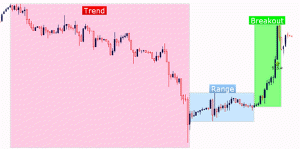
Often, it behooves us to try to trade a ranging strategy when markets are showing us range-bound behaviors. And if the market is volatile and moving quickly, then we often want to be trading a breakout-related strategy.
It's important to keep this in mind as we build our strategies. As humans, we often can't help but strive for perfection. Unfortunately, as traders, this can be a fatal mistake, as perfection is not only impossible, but its pursuit can carry costly repercussions. Building a strategy is the art of concentrating on net results, and focusing our strategies on market conditions specifically for which they are designed can help traders focus on producing the strongest net results.
So, before we even begin to design the strategy, we first have to answer an important question: What market condition do I want to design this strategy for?
How to Pick a Condition
Market conditions can be split into three groups: ranges, breakouts, and trends; each with a different idea of when the best time to buy or sell might be.
Range-Bound Markets
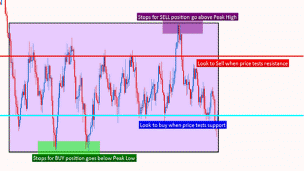
Ranges are highlighted by adherence to a channel of prices. During ranging market conditions, prices will respect the boundaries of support and resistance, and it often behooves traders to employ the age-old mantra of "Buy low, sell high."
Ranges can be common in quiet markets, or even in congested periods when traders don't have enough information to move price higher above resistance or lower below support.
The chart below will illustrate a range, as indicated with price action, using the mechanism we outlined in Swing Trading the Forex Market.
Click to Enlarge
Unfortunately, ranges don't last forever. Most of the time, a fresh piece of news hits the market and traders rush to bid price higher or drive price lower as that news is factored into the environment. These fast markets can be highlighted by large, volatile, and unpredictable moves.
This is how ranges become breakouts: the market environment receives a catalyst that pushes price beyond the previously defined boundaries of support and resistance.
NEXT PAGE: Trading Breakouts and Trending Market Conditions
|pagebreak|Trading Breakouts
After support or resistance is broken, price can continue to run for an extended period of time. Looking to enter trades in anticipation of those breaks of support or resistance is trading breakouts. Often, entry orders (pre-set orders to open trades when prices are hit) are the preferred method of trading breakouts.
When planning breakouts, it's important to keep in mind that nobody knows when, if, or how support or resistance may be broken, so it's impossible to determine how a breakout may take place before it actually happens; and when support or resistance is broken, how do we know that price is going to continue driving in that direction?
Well.we don't. This is quite a bit more uncertainty that is introduced to the trade, but luckily, traders have a litany of factors to attempt to adjust for this uncertainty.
The good news is if a trader is successful in a breakout trade, price can often run for an extended period of time, allowing the trader to collect a considerable number of pips. It's just that with breakouts, traders will usually be wrong more often than they are right.
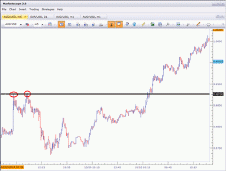
The picture below illustrates a classic breakout on AUD/USD, as price was previously twice rebuffed at resistance. Notice that the third attempt was the charm, as price ran for an extended period of time after resistance was broken.
Click to Enlarge
Notice that after resistance is broken on AUD/USD, price continues moving higher. As a matter of fact, after support or resistance is broken, a currency pair may go on to trend for an extended period of time.
Trends
These trends can often be a trader's best friend, offering a bias with which the trader can look to trade in a pair.
Trend traders will often wait for major levels of support or resistance to be broken so that a trend can be exhibited on the chart. Trend traders will then look to employ that same age-old mantra that range traders will employ of "Buy low, sell high," only the trend trader is applying the bias of a trend.
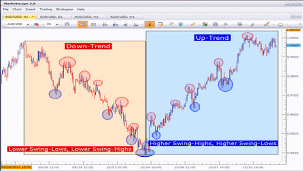
Below is a chart showing both an uptrend and a downtrend:
Click to Enlarge
Downtrends are highlighted by series of lower lows and lower highs, while uptrends are accentuated by higher lows and higher highs.
There are quite a few ways of quantifying a trend. Many traders like to rely on indicators such as moving averages to assist with identifying these trends. Other traders may elect to forego indicators altogether, instead focusing on price action itself to grade trends (as we had looked at in the above graphic).
In these markets, traders often want to look to buy uptrends "cheap," while selling downtrends "expensive." There are numerous ways to classify what may be cheap or what may be expensive, and this will be covered in an upcoming article in this series.
In our next article, we will begin to examine the various time frames that traders have available to place their trades.
By James Stanley, Trading Instructor, DailyFX.com