
When a failed break occurs, you are on one of two sides of the trade. The staff at Investopedia explains how you can make sure that you’re on the winning side.
As a trader, you've probably been told that it's best to trade breakouts and breakdowns. Countless chart patterns exist to help you pinpoint exact entries and place effective stops.
Knowledge of these patterns and strategies is commonplace among retail traders. And indeed, the strategies work in most situations—if they didn't, then technical analysis would not work. However, this type of predictable behavior begs the question: why doesn't someone take the other end of the trade? Why wouldn't someone purposely break through the predictable stops, knowing that it would crash the prices?
The truth is that this situation does take place on a regular basis. It's called a failed break, and the resulting signal is often more reliable than the original breakout or breakdown. What constitutes a failed break, and how can you turn a potentially disastrous position into a profitable one?
Anatomy of a Failed Break
To get a better idea of how to trade these failed breaks, let's first take a look at the anatomy of a failed breakout:
- A breakout occurs.
- The breakout fails by dropping below the new support (old resistance).
- As a result, stops of short-term traders are hit at predictable levels.
- Triggering these stops causes the price to drop (similar to the way it drops after a short squeeze, as there is a frantic search for buyers in both cases).
- The drop slows down after stops are hit and covered.
- The drop stops and reverses after the price reaches a new major support level, or a fundamental reason causes a reversal.
These are the key validation points:
- The volume is there to confirm the stops being hit.
- The original chart pattern showing the breakout is accurate.
Trading Failed Breaks
When a failed break occurs, you are on one of two sides. Either you traded the breakout and are looking to exit your position, or you are looking for an entry after a failed breakout occurs.
If you traded the breakout and are caught on the wrong side of the trade, you should try to exit before the price hits the predictable stop-loss levels. This will help you avoid slippage, which can be seen in illiquid stocks when failed breaks occur. Then you can look to re-enter in the opposite direction, assuming that you are sure that the breakout failed (i.e. the movement is not simply market noise).
NEXT PAGE: How to Handle Failed Breaks
|pagebreak|Let's look at an example of a trade setup to illustrate how a typical trade might go:
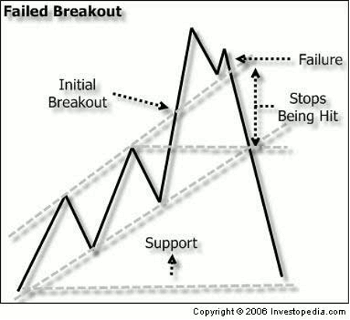
Figure 1
Click to Enlarge
In Figure 1, we are looking to take a short position as soon as the breakout fails. Then we would sell half our position after the initial drop, at the top horizontal gray line. This is to take some money off the table in case a rebound occurs. Finally, we would sell the remainder of our position at the next major support level, indicated by the lower horizontal gray line.
Other Techniques
There are also some strategies that rely on failed breaks to validate a pattern. The most popular example of this is the Wolfe Wave pattern.
Here's an example of a Wolfe Wave:
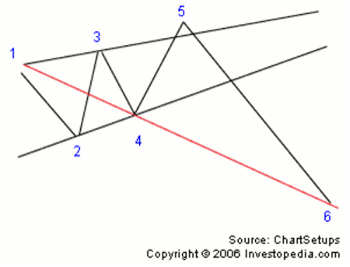
Figure 2
Click to Enlarge
Notice that the fifth wave of the Wolfe Wave pattern mandates that a breakout take place, which is then followed by a large move in the opposite direction to point 6. This pattern is surprisingly accurate, and makes good use of the accuracy of the failed break phenomenon.
NEXT PAGE: Examples to Further Reinforce These Concepts
|pagebreak|Examples
Let's look at a few more examples to further reinforce these concepts.
In Figure 3, we see an example of a Wolfe Wave pattern that appeared on the chart of BASF Corporation (BASF) from late July 2005 to late October 2005.
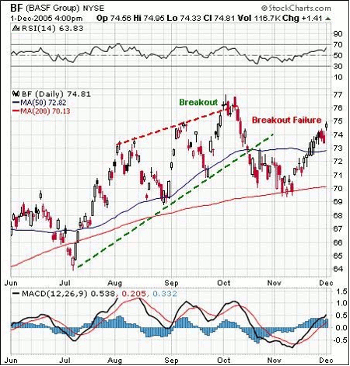
Figure 3 - Source: StockCharts.com
Click to Enlarge
Now, we notice that the stock appeared to break out above the upper channel, creating a new high. The stock then quickly fell below the breakout level, creating a failed breakout. Using the Wolfe Wave principles, we can calculate the breakout as ending around the $70 level by connecting points 1 and 4.
In Figure 4, we see an example of an ascending triangle pattern that appeared on the chart of Doral Bank (DRL) from November 2005 to March 2006.
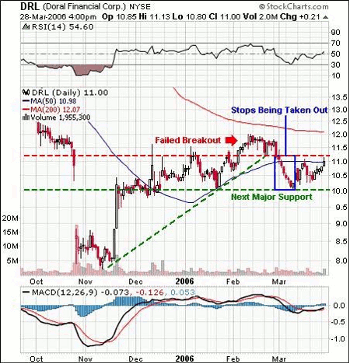
Figure 4 - Source: StockCharts.com
Click to Enlarge
Notice that DRL breaks out from an ascending triangle/horizontal channel formation. This turned out to be a failed breakout as the stock quickly plummeted after dropping below the newly created support level. This caused a series of stops to be hit that dropped the price down to the next major support at $10.
In both of these examples, we can see that a failed breakout produced a quick move in the opposite direction. In the Wolfe Wave example, we used the Wolfe Wave principles to derive an exact turning point. Meanwhile, in the ascending triangle formation, we were able to pinpoint support by looking at the next major support.
The Bottom Line
As we've seen, failed breaks can offer great opportunities to profit. As more and more retail traders embrace the same predictable strategies, these failed breaks will likely become increasingly apparent in the marketplace. It is important to learn to identify them in order to save money when your breakout plays turn bad, and also to tap into potential profit based on the predictable behavior of others.
This article was written by the staff at Investopedia.com.