
Trader and educator Jeffrey Kennedy of ElliottWave.com shares a real-market example that illustrates how impulse wavescan help traders accurately identify and trade important turning points in any market.
Impulse waves are an integral part of the Wave Principle. Understanding their rules, guidelines and Fibonacci multiples will improve your application and ability to identify high-probability trade setups.
There are three rules that govern impulse waves:
- Wave two may never retrace more than 100% of wave one;
- Wave three may never be the shortest impulse wave of waves one, three and five. It does not have to be the longest, but it may never be the shortest; and
- Wave four may never end in the price territory of wave one.
Fibonacci multiples are the mathematical basis used to identify wave objectives. For example, we often tend to see a deep retracement in wave two. A .618 multiple of wave one and .382 multiple of wave three are the most common Fibonacci retracements for second and fourth waves. Fibonacci extensions for waves three and five include .618, 1.000, 1.618, 2.000 and 2.618.
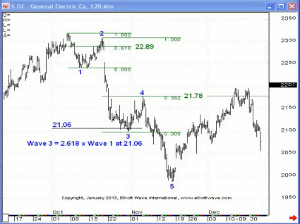
For example in this 120-minute price chart of General Electric (GE), we have an initial move to the downside. Notice the deep retracement in wave 2—we go back to beyond the .618 retracement at 22.89.
Click to Enlarge
From there, we see a wave three decline followed by a fourth wave bounce—a correction—back to the .382 retracement of wave three at 21.78.
The most common Fibonacci retracement for a fourth wave is a .382 multiple of wave three.
The most common Fibonacci retracement for a second wave is a .618 multiple of wave one.
You may notice another extension, or multiple, on this price chart coming in at 21.06. At that level, wave three equals a 2.618 multiple of wave one.
Within the structures of an impulse wave (or in corrections, for that matter), each wave of the pattern is going to have some type of Fibonacci multiple or ratio to prior waves within the structure.
One of the most relevant guidelines pertaining to impulse waves is that when an impulse wave completes, a correction occurs that pushes prices back into the span of travel of the previous fourth wave (most often ending near its terminus).
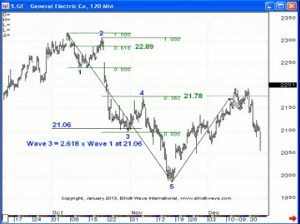
If we apply this to GE, you can see how it works:
Click to Enlarge
When we finished the 5 wave decline, it set the stage for a countertrend move back up to the previous 4th wave extreme.
By Jeffrey Kennedy of ElliottWave.com