
Ever since the inception of weekly options on the major ETFs, I have been trading them consistently, though I have only written about them sporadically.
In this article, I will go over a lesson about complex spread execution on the weeklies. I love to enter my short verticals, or iron condors, just before the bell on Friday afternoons. The logic behind it is very simple: Sell the theta over the weekend and suffer limited market exposure due to the fact that over the weekends, the markets are closed. Certainly, there is always a possibility of a gap up or down, which I am willing to take. Rewards are always tightly connected with the risk.
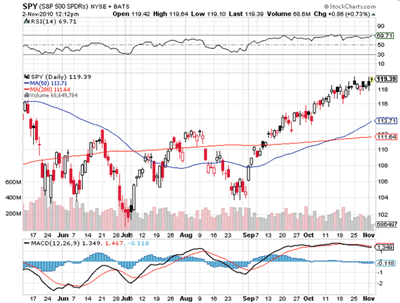
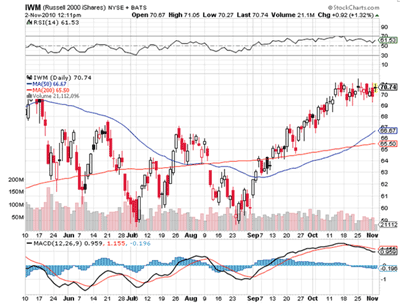
Anyhow, last Friday just before the bell, I was placing a spread on two ETFs: SPY (S&P 500 tracking exchange traded fund) and IWM (Russell 2000 tracking exchange traded fund).
The First Trade: Iron Condor on SPY
At 12:43 pm PT, just about 17 minutes before the bell, I sent in my SPY iron condor trade for a credit of 26 cents and it filled instantly. The fact is that the spread was trading at 22 cents as natural and 26 as the mid price between the bid and ask spreads of these multiple-leg options. The exchanges would "naturally" want to give me less money for my spread, so asking 26 cents, or the mid price, seemed like an aggressive trade. The moment I sent in the order, I was instantly filled.
Click to Enlarge
Frequently, when that happens, it means that I have asked too little, and one of the reasons for sending only a foot soldier (a single contract spread) in first is mainly because of that. My very next order was for a penny more, or 27 cents, and I increased the size to nine contracts, which would in turn give a total of ten contracts, or my original intention.
The order for nine contracts of iron condors was filled about six minutes later at the limit price that I had specified, 27 cents per contract. The spread between the strikes was one point and the credit was 27. The difference between the strike spread, $1 in this case, and the credit of 27 cents, means that my maximum loss on this SPY iron condor would be $730 for ten contracts. The max profit is $270, while the rate of return is (27/73) 37%.
NEXT: The Iron Condor Trade on IWM
|pagebreak|The Second Trade: Iron Condor on IWM
My second iron condor was on IWM, and the credit I asked for was 27 cents, the spread being 23 natural and 27 mid. I entered that order at 12:34 pm PT, and as it did not get filled in a couple of minutes, I lowered it from 27 to 26. I left that order for 26 on from 12:36 until 12:41, and then when it again did not get filled, I lowered it even more to 25 cents. To make a long story short, that too did not get filled, so I lowered it for a third time to 24 cents, and at 12:53, it became clear to me that I would not get filled on that either. By the way, the market in those last 30 minutes did not do much.
Click to Enlarge
In order to understand why I am not getting filled at 24 cents when the spread is still 23 natural and 27 mid, I looked at the Level II. It showed that certain exchanges were quoting the premiums at different price levels, while my platform was picking up the tightest spread between the bid and ask and quoting it. Had I been trading a single-legged option, I would be able to get in somewhere between the natural and the mid. However, due to the fact that an iron condor has four legs and is considered by the exchanges to be a complex spread, the order I was sending had to be accepted as a whole, single order by the same exchange. As time passed, there was more chance that I might not get filled at the price that I wanted.
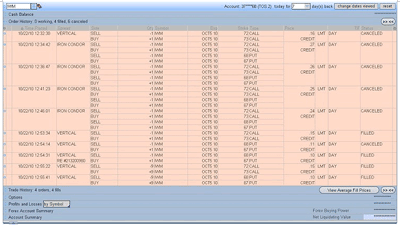
In order to get filled at my terms, I chose to break up my iron condor into two spreads. First, I sent in my foot soldiers (single contracts); namely, a bear call for 15 cents and then a bull put for 11 cents. The bull put did not get filled at 11 cents, so I tweaked it to ten cents and that went through. Next, I sent in nine more contracts on each side (bear call and bull put). They also were filled at the same price as the single contracts about five minutes before the bell. The figure below shows the order history of both the filled and canceled orders on this IWM trade.
Click to Enlarge
The conclusion is that my IWM iron condor spread would not get filled even at 24 cents per share (as a whole) due to the fact that all of the legs had to be filled by the same exchange. Once I split the order into two simple short vertical spreads, two different exchanges filled me for an even better price than 24 cent per share. (The bear call for 15 cents and bull put for ten equal a total credit of 25 cents). In this particular case, legging into a condor worked well because the underlying had not moved much between my bear call entry and bull put entry, and I ended up getting filled better in pieces than what I would’ve had I waited stubbornly for my entire iron condor to get filled.
Have a green trading day!
By Josip Causic, instructor, Online Trading Academy