The Invesco QQQ Trust (QQQ) was recently back in the headlines, but not for performance reasons. This time it’s structural. Meanwhile, two alternatives that might be worth considering are the Vanguard Mega Cap Growth ETF (MGK) and the iShares Expanded Tech Sector ETF (IGM), notes Tony Dong, lead ETF analyst at ETF Central.
Invesco has announced plans to seek shareholder approval to convert QQQ from its outdated unit investment trust (UIT) structure into the open-ended format used by nearly all modern ETFs today. According to the ETF Central screener, QQQ ranks as the fifth most popular US-listed ETF, with around $361 billion in assets under management.
But QQQ was never explicitly built as a tech or growth fund. Its index methodology is pretty simple: Hold the 100 largest stocks (excluding financials) listed on the Nasdaq. Because the Nasdaq exchange has historically attracted tech listings, QQQ became a de facto innovation proxy.
QQQ, MGK, IGM (YTD % Change)
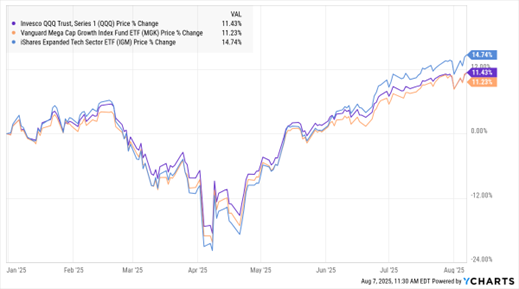
Data by YCharts
If you're looking for more targeted exposure, whether to tech dominance or large-cap growth, there are other ETFs worth considering. One is the MGK. It tracks the CRSP US Mega Cap Growth Index, holding 69 stocks selected.
There’s meaningful overlap between the two funds. But MGK’s broader eligibility, without QQQ’s Nasdaq-only and no financials restriction, means it also includes NYSE-listed growth giants like Eli Lilly & Co. (LLY), S&P Global Inc. (SPGI), and Visa Inc. (V).
As for IGM, it gets around a key issue: Most traditional tech ETFs follow the GICS sector classifications, which exclude several of the biggest names people associate with technology. Instead, it tracks the S&P North American Expanded Technology Sector Index, which includes a broader set of 280 companies.
Another feature that sets IGM apart is its North American focus. That gives you exposure to a few non-US names, including Shopify Inc. (SHOP), a Canadian e-commerce firm that’s often excluded from other ETFs because it's domiciled in Canada, even though it's dual-listed and widely followed by US investors.