
Is this time for a new generation to learn that precious metals are fickle bedfellows? The answer will heavily depend on when you bought. The recent action suggests a peak of at least near-term and potentially medium-term significance, writes Eoin Treacy, editor of Fuller Treacy Money.
David Fuller had a maxim that is as true today as at any time in the last half century: “Don’t Pay Up For Commodities.” That phrase carries a great deal of meaning and requires some understanding of how commodities tend to trade.
They are volatile. That means the surprises will be on the upside during bull phases and on the downside during bear phases. Volatility also means that breakouts have a habit of failing on both the upside and the downside.
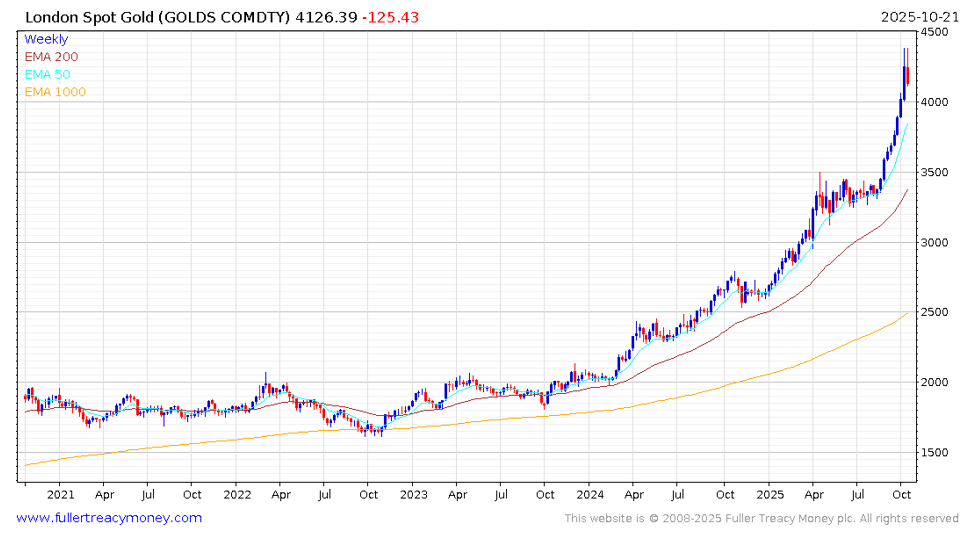
If the most consistent trends look like a staircase of ranges one above the last, many commodity charts look like the serrated edge of a steak knife. The reason many experienced investors think of precious metals as fickle is because they disappoint in holding breakouts as much as they outperform when breakouts succeed.
Gold hit an intraday peak earlier this week of $4,381. It then closed at $4,120. A $260 drop represents a large downward dynamic. Silver hit its peak on Friday at an intraday high of $53.76. It then closed at $47.93.
Gold has been in a strong momentum-driven uptrend since early 2024. We can see from the chart that it has held mostly above the 50-day moving average since October 2023. The only time it spent more than a week below that trend mean was in late 2024. Even then it closed below it for one week and bounced back the week after.
The recent nine-week breakout in gold took the price further from the 50-day moving average than at any time in the last couple of years. Some consolidation would be healthy for the trend. That would unwind the short-term overbought condition and set the stage for the next part of the uptrend.