
Tony Robbins is quoted saying: “Do something. Get results. Decide if it's worth repeating.” Back in July 2024, I wrote about Buffer Funds. I have decided it’s worth repeating given current market conditions, writes John Gardner, founder and principal of Blackhawk Wealth Advisors’ Market Insights.
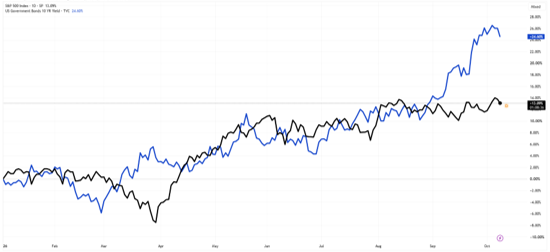
The basic purpose of Buffer Funds is to balance principal protection and performance. That is a growing demand for many investors today. With benchmark bond yields at 20-plus year highs, the S&P 500 Index (^SPX) at all-time highs, and a stock bull market nearly four years old, a balanced investment focused on risk mitigation is timely.
10-Year Treasury Yield (Blue), S&P 500 Index (Black) - YTD % Change
Source: TradingView
Stated simply, Buffers seek to track the return of the S&P 500, or another stock index, up to a redetermined cap...while buffering investors against losses over the outcome period, typically one year. For example, a recent 1-year Buffer Fund provided a 20% protection (the "buffer") and an upside max return of 10% (the "cap").
Stock investors would naturally see a Buffer as a sacrifice of perhaps higher long-term compounding gains when they cap their upside. True. For these investors, Buffers would likely be suitable for the conservative/defensive portion of their equity allocation.
But the “sacrifice” argument deserves some proper perspective. Over the past 30 years (1996–2025), the S&P 500 delivered an annualized total return of 10.4%. So, owning a Buffer with a cap that limits a 1-year gain of “only” 10% isn't really a sacrifice relative to the norm.
Also, the Buffer Fund is suited best for conservative investment. Its name gives it away. The “buffer” component reduces risk, which is especially valuable in abnormally volatile periods.
While not for everyone and likely not all of anyone's investable funds, a Buffer Fund can be of value. They may now be uniquely timely after a long, strong advance in stocks for an investor wanting to maintain stock market exposure but with less risk and willing to settle for “just 10%.”
Subscribe to Blackhawk Wealth Advisors’ Market Insights here…