Let’s set the Nvidia Corp. (NVDA) news aside for a moment and focus on the other elephant in the room. It’s the macro-AI trade on the heels of the Blue Wave...and the many comparisons to the Internet and broadband buildout bubble, writes Nancy Tengler, CIO of Laffer Tengler Investments.
I’ll start with claims that tech capex has reached unsupportable levels. The story goes that spending as a share of GDP has shot up to 5.4% — faster than during the Internet bubble of the 1990s. The skeptics claim the spending has become too big and the companies are overinvesting.
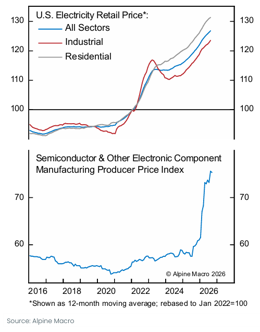 But the important difference is that during the Internet boom, prices for fiber-optic cables, telecommunications equipment, and semiconductors were falling. Dramatically. That meant that nominal growth understated real investment growth. Or in other words, the companies were building more for less.
Today, the story is exactly the opposite. Using semiconductors as an example, compare how prices from the Internet bubble buildout (1995-2005) were down 25% versus prices that have grown 22% since the beginning of this year. To examine further, we see that the cost for electricity (a critical input for AI infrastructure) has risen 30% since 2022 – and the hourly rental of NVDA's B300 GPU is up 60% since March of this year.
In other words, the hyperscalers are building less for more. When price increases (inflation) account for a significant portion of spend, the numbers alone don't tell the story.
When adjusted for inflation, the acceleration in tech capex as a percent of real GDP is more muted. Companies are building less (if you will) for more.
Meanwhile, technology stock valuations have fallen 25% year-over-year. Earnings have continued to grow dramatically while stock price performance has moderated. We believe much can be laid at the feet of capex over share buybacks, but that is just a hunch. For now, we are staying put with our technology holdings.