
Stocks are subdued in early trading, while crude oil is bouncing between positive and negative territory. Gold and silver are mixed, while the dollar and Treasuries are flatlining.
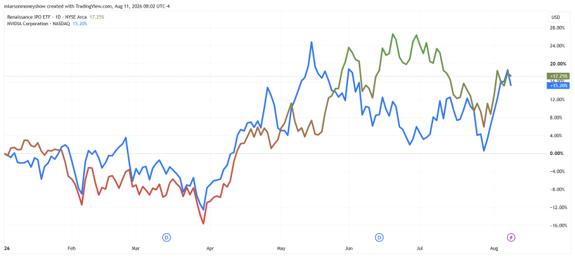
Anthropic is powering ahead in its race to an Initial Public Offering (IPO) sometime next month – or early October at the latest. But the AI giant behind the Claude model is facing investor questions about growth, Chinese competition, data center construction backlash, and other challenges. The private company sports a valuation of around $965 billion.
IPO, NVDA (YTD % Change)
Source: TradingView
Meanwhile, Nvidia Corp. (NVDA) is attempting to tap into institutional capital to raise as much as $500 billion for AI spending. The chipmaker linked up with six asset managers, including Goldman Sachs Group Inc. (GS) and BlackRock Inc. (BLK), to package compute power as an investible asset.
Firms could theoretically invest in GPUs and data center capacity just like they buy mortgage-backed securities made up of thousands of individual loans or toll roads that throw off predictable amounts of cash. The push will take time to get off the ground though – and comes as hyperscalers and other AI sector players are already raising hundreds of billions of dollars in the traditional equity and debt markets.
US crude oil futures closed in on $85 a barrel in early trading before retreating on headlines out of Pakistan. The country has been acting as a go-between for US-Iran talks and its defense minister suggested “we are close to some sort of arrangement.”
Still, WTI prices remain well above their June low around $68.50 – and headline risk continues to bedevil traders. The CBOE Crude Oil Volatility Index (^OVX) spent most of 2024 and 2025 trading in the 30s. But the vol index spiked as high as 123 in March – and has vacillated between 50 and 70 for the last month.
In other energy market news, the US Strategic Petroleum Reserve (SPR) just sank to 298.7 million barrels. That’s the lowest since 1983. The government has been releasing oil into the market to offset supply disruptions caused by the Middle East conflict.