

Momentum trading rests on a simple premise: Stocks that are rising tend to keep rising, while those that are falling tend to keep falling. Investors identify strong trends and ride them until they weaken. But the risks are significant, advises Lance Roberts, editor of Bull Bear Report.
This strategy relies heavily on technical analysis and often involves short holding periods. Momentum thrives in bull markets. Herd behavior pushes winners higher, creating self-reinforcing trends.
But trends can reverse quickly. Benjamin Graham warned: “The more you trade, the more you are likely to lose.” Frequent trading increases costs and exposes investors to sharp reversals when sentiment shifts.
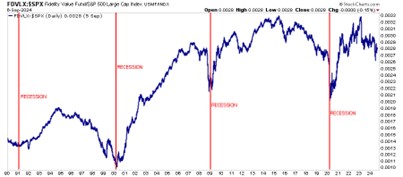
The chart shows the difference in the performance of the “value vs. growth” index – the Fidelity Value Fund (FDVLX) versus the S&P 500 Index (^SPX). Notable are the periods when “value investing” outperforms.
While it may seem like the current bull market will never end, abandoning decades of investment history would be unwise. As Howard Marks once stated:
Rule No. 1: Most things will prove to be cyclical.
Rule No. 2: Some of the most exceptional opportunities for gain and loss come when other people forget Rule No. 1.
Momentum is not about fundamentals. It is about psychology and timing. That makes it risky for most investors. If you are going to trade that way, keep these tactics in mind:
- Use strict stop-loss orders to protect capital.
- Limit position size and portfolio exposure.
- Focus on liquidity. Stick to names where you can exit quickly.
- Be disciplined about exits. Do not wait for confirmation once momentum fades.
- Treat momentum as tactical, not core.