Concerns about the $1.4 trillion private credit market resurfaced last week when alternative asset manager Blue Owl Capital Inc. (OWL) surprisingly restricted withdrawals from one of its funds and sold off part of the loan portfolio of another fund to raise cash. That’s why you should monitor the Baa/Treasury credit spread, advises Tom Essaye, president of the Sevens Report.
Traders are concerned that the private credit market is teetering and poised to experience potentially painful drawdowns. Blue Owl’s sudden moves reminded investors of First Brands and Tri-Color Holdings, two alternative lenders that suddenly went bankrupt in late 2025.
We monitor the Baa/Treasury credit spread, which is basically the “Junk/High Yield” spread minus the same-duration Treasury spread. It’s an indicator of economic stress and general concern about funding and liquidity.
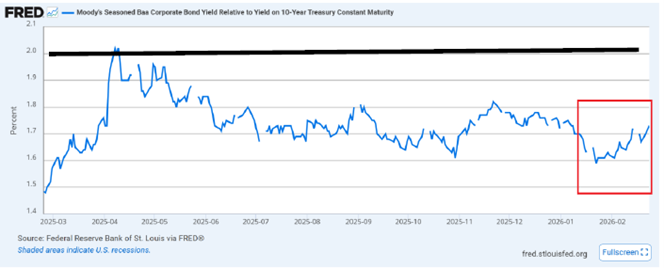
If we start to see more stress in private credit, then this spread will begin to widen sharply and quickly. That will be a sign that contagion is starting to appear. And that would be demonstrably negative for markets.
Thankfully, there are no signs of that occurring yet. The Baa credit spread currently sits at 1.73%, which is up slightly from the lows of the year at 1.59%, but well off the one-year highs of 2.02% last April. If the Baa credit spread rises solidly above 2%, that will be a sign that stress is emerging about private credit or some other funding source and that will get our attention.