

We recently had a very nice profit on a long run by the iShares Silver Trust (SLV). We rolled that position seven times, each time taking a credit from selling a relatively deeply in-the-money call option and replacing it with an at-the-money call. Here are the lessons for traders from that process, notes Lawrence McMillan, editor of Option Strategist.
First, one is constantly putting money in the bank, since each roll is done for a credit. That’s a big psychological edge in my opinion. When you know you’re “playing with the house’s money,” you can think less emotionally about your next move.
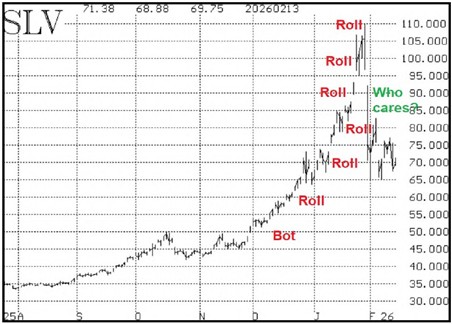
Second, if a major reversal occurs, you only lose the price of the last call you purchased – all the other credits are already in the bank. That happened here, when SLV dropped from 110 to 65 (intraday high and low) in less than two full trading days, on Jan. 29 through Feb. 2nd.
We originally recommended the purchase of the SLV Jan 16. 45 calls in the Nov. 24, 2025, newsletter. We paid 2.70 for those. Then we rolled up the strikes every seven or eight points…but eventually were rolling up every 10 points.
For all practical purposes, SLV was at the indicated strike when the calls were rolled up. We never rolled to the 110 calls, because SLV never traded at 110, although it came close.
The chart above shows the graph of SLV and the points and frequency at which the rolls took place. The “Who cares” notation means that when the ETF finally imploded, we only lost the last call premium, so “who cares?”