

We recently discussed the ongoing internal battle with the markets as “trapped longs” look for exit points. While the S&P 500 Index (^SPX) is under pressure, that headline number is masking something far more critical beneath the surface, cautions Lance Roberts, editor of the Bull Bear Report.
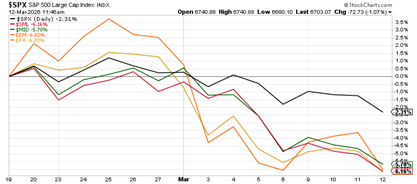
Yes, the index itself has pulled back from recent highs. But the real damage is being done in pockets of the market that saw the most aggressive momentum chasing at the start of the year. Emerging markets, international equities, small-caps, and mid-caps are getting hit materially harder, and that shouldn’t surprise anyone who was paying attention.
We highlighted the extreme bifurcation building inside the market. The perceived “value-oriented” sectors – like energy, materials, industrials, and staples – had surged 12%–21% year-to-date, while the broader index sat essentially flat. That divergence, driven by the “reflation narrative,” was a warning sign, not a buying opportunity.
When capital crowds into slow-growth, economically sensitive sectors while abandoning quality growth, the market’s internal structure weakens. Breadth narrows, volatility rises, rallies shorten, and drawdowns accelerate.
So how should traders navigate this environment?
- First, resist the urge to chase the next narrative. The rotation into value and international wasn’t a structural shift — it was a sentiment-driven overcorrection. Chasing it now, on the back side, compounds the risk.
- Second, quality matters more in a drawdown than in a rally. The growth and technology sectors that were sold most aggressively still hold the strongest balance sheets and the highest margins. When selling pressure is driven by de-risking rather than deteriorating fundamentals, those positions tend to recover first.
- Third, manage what you can control. Tighten stops. Rebalance toward target weights. Reduce concentration in areas that are extended or fundamentally dependent on a macro regime that may already be fading.
The goal isn’t to predict the next move. It’s to avoid being forced out of good positions by accepting too much risk in the wrong ones.