

In a recent video, Michael Lebowitz and I discussed why Treasury yields cannot simply keep rising indefinitely without fundamental support — and why the Federal Reserve’s reliance on the elusive “term premium” could set the stage for another major policy mistake. Here’s what it means for traders, writes Lance Roberts, editor of the Bull Bear Report.
Unlike stocks, where sentiment and speculation often dominate short-term price movements, the bond market is primarily driven by fundamentals. Treasury yields reflect inflation expectations, real interest rates, economic growth, monetary policy expectations, and compensation for future uncertainty.
10-Year Treasury Note Yield (^TNX)
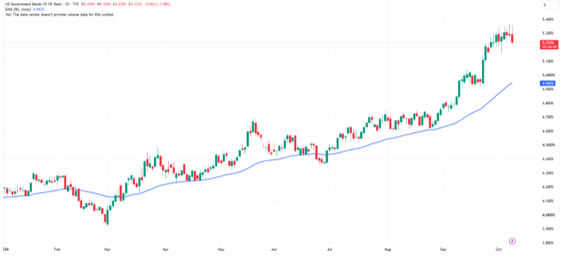
Source: TradingView
When I constructed Michael’s analysis, the 10-year Treasury yield stood at 5.26%. I broke it down into three major components:
- 2.3% breakeven inflation, reflecting inflation expectations, Fed credibility, energy prices, and wages.
- 1.9% real interest rate, tied to economic growth, productivity, and monetary policy expectations.
- Approximately 1% term premium, representing additional compensation investors demand for holding longer-term bonds.
The key point? Term premium is only one component of Treasury yields, and its influence is constrained by underlying fundamentals and market supply and demand.
But here’s the problem: Nobody actually knows precisely how large the term premium is. Different Wall Street and Fed models produce estimates ranging from 61 basis points to 140 bps. My estimate is roughly 100 bps, while Michael’s model suggests just 77 bps.
If the Fed underestimates how restrictive higher long-term yields have already become, it could tighten too aggressively, unnecessarily weakening economic growth and increasing recession risks. Conversely, if policymakers mistakenly conclude that rising yields have already tightened financial conditions sufficiently, they could hold back on necessary rate hikes and allow inflation to persist.
My biggest concern isn’t simply that Treasury yields could rise further. It’s that the Fed may misunderstand WHY they’re rising — and make a costly policy mistake as a result.