
Sometimes the biggest move in a stock has nothing to do with the company behind it. That’s precisely what happened with Gold Resource Corp. (GORO) and Goldgroup Mining Inc. (GGAZD) a few weeks ago, when a technical mechanism buried inside the world of stock index reconstitution triggered a wave of forced selling, observes Brien Lundin, executive editor of Gold Newsletter.
On July 17, Goldgroup Mining Inc. (GGAZD) closed its merger with Gold Resource Corp., the American producer behind the long-running Don David Gold Mine in Oaxaca, Mexico. Under the terms of the deal, Gold Resource shareholders received 0.3619 Goldgroup shares for each share they held…and Gold Resource became a wholly owned subsidiary of the newly combined, Canadian-domiciled Goldgroup.
Goldgroup Mining Inc. (GGAZD)
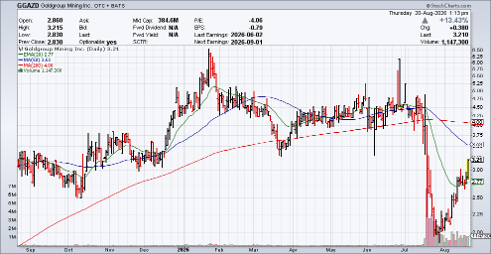
The merger created a single company with a dual listing on the TSX Venture Exchange and the NYSE American under the ticker GORO. But get this: Gold Resource had just been added to the Russell 2000 Comprehensive Factor Index after the annual Russell US Indexes reconstitution took effect on June 26.
FTSE Russell then determined the newly combined company no longer met the index’s nationality eligibility requirements — a classification tied entirely to Goldgroup’s Canadian home-country status. It notified the company it would be removed effective July 20, the very next trading session after the merger closed.
The selling that follows a removal like this isn’t a discretionary decision made by any individual investor — it’s structural and automatic. Funds that track the Russell 2000 are required to hold whatever the index holds, and when a stock is dropped, those funds must sell their entire position within a tight window.
The mandatory selling window drove the stock down by roughly 50% over about a week of trading. So, what happens next? That’s the real question. Goldgroup closed its merger with roughly US$46 million in cash and zero debt, four 100%-owned assets spanning current production and near-term growth, and a dual listing that broadens its reach across Canadian and US capital markets.
None of that changed when FTSE Russell applied its nationality rule. Now is the moment to take a closer look at what the index-driven selling left behind.