
Markets are subdued – for now – in the final trading day of a week marked by powerful rotation behind the scenes. Gold and silver are modestly higher, while crude oil is flat. The dollar and Treasuries are a tad lower.
Federal Reserve Chair Kevin Warsh spoke at a key economic event in Thailand overnight. But keeping with his preferred practice, he didn’t provide advance guidance about what the Fed will do at its next policy meeting set for Oct. 27-28.
Markets dialed back their bets on a potential 25 basis point hike anyway in the wake of Warsh’s comments, while continuing to speculate on a move at the Fed’s final meeting of 2026. That one concludes Dec. 9 - and rate futures markets were recently pricing in a 79% change of a quarter-point increase in the federal funds rate to a new range of 4% - 4.25%.
Rate Outcome Probabilities (December FOMC Meeting)
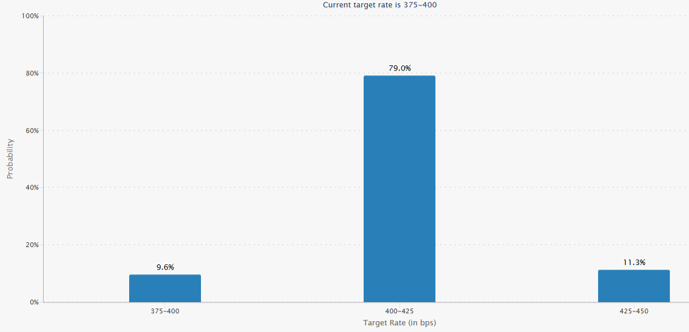
Source: CME FedWatch
As for the meeting Warsh is attending in Bangkok, it’s a gathering of financial policymakers from around the world held annually by the International Monetary Fund (IMF) and World Bank. AI was front and center on the agenda, with attendees discussing how essential the AI buildout is for global growth – and what could happen if the boom fizzles.
Spending on AI data centers and related infrastructure in the US alone could total a staggering $10 trillion through 2032. A continuation of the AI boom could drive enormous growth and tamp down inflation by boosting productivity...while an AI bust could shave 1.3 percentage points off global growth by 2028, according to IMF modeling.
Speaking of which, the boom-bust debate is playing out this week in a key AI-levered stock: CoreWeave Inc. (CRWV). The neocloud company’s shares and bonds first tanked, then rallied, amid a back-and-forth debate about the cost – and financing requirements – of the AI buildout. The company has raised billions of dollars in the equity, debt, and loan markets to build out its cloud computing infrastructure. This week, the yield on its junk bonds surged as default fears mounted.
Finally, we have an emerging markets kerfuffle to keep an eye on. Indonesia’s Jakarta Composite Index plunged almost 12% overnight – its worst drop since 1998 – and its sovereign bonds and rupiah currency tanked alongside. The country’s market was already under pressure, too, with the iShares MSCI Indonesia ETF (EIDO) down 37.9% as of Thursday’s close.
Fueling the declines: The stock index provider MSCI Inc. is considering downgrading Indonesia to so-called “standalone-market” status due to governance, liquidity, and transparency concerns in the country. That would lead to even more outflows from passive funds that track emerging markets. Economic and market reform pledges from Indonesian President Prabowo Subianto haven’t proven robust enough to stem capital flight.