

Technicals support an upside breakout in stocks, but equities—as we have learned—are dependent of the Fed, writes Joe Duarte.
With earnings season gearing up and rising election and Covid-19 uncertainty, the actions of the Federal Reserve are now more important than ever. No doubt, no one knows which way the future will unfold. Yet, at least in the markets, technical analysis can help us sort through the clouds of uncertainty, especially over the next few months.
A couple of weeks ago I noted that the New York Stock Advance Decline line (NYAD) was close to triggering a Duarte 50-50 Rule sell signal. The signal appears when the NYAD falls below its 50-day moving average at the same time that the corresponding RSI indicator falls below its own 50 level.
Luckily for bullish investors, the signal failed to fully materialize, and the uptrend remains intact for now. However, another important indicator is telling us that a big move in the stock market is likely in the near future. Investors should ask these important questions:
- What is the status of Federal Reserve liquidity?
The primary foundation under this market recovery is the Federal Reserve and QE. There were two concerning items regarding the Fed last week. One was that the New York Federal Reserve is floating the idea that if markets continue to do well, they may actually stop QE. The second was that the Fed’s balance sheet has shrunk three weeks in a row, a factor that has coincided with recent market volatility.
- What is the dominant market trend?
The dominant market trend remains up, but we are clearly in a consolidation pattern that looks set to resolve soon. Moreover, the direction of that move is the key to the market’s trend.
- Are my stocks keeping up with the dominant market trend?
Regardless of the market trend, if what you own isn’t working, it’s probably time to rotate. Consider taking profits in stocks which have gained 20% or more, and get rid of losers, especially if the market is up and you still own stocks that are down more than 5%.
- What’s on my Radar Screen?
Once you’ve optimized your portfolio, if the trend remains up, it’s a good idea to replace the stocks you sold with ones that are acting well. Ideally you want to stack the deck with companies whose management is doing the right things and whose price charts are showing signs of accumulation.
What’s up with Gilead Sciences?
We pointed out to you in February that Gilead Sciences (GILD) could be a stock to watch as it was testing a drug it created, remdesivir, as a treatment for the Coronavirus, which had the possibility of growing into a global pandemic.
More recently, we discussed that value of the stock based on preliminary success of trials on Covid-19 patients. And very recently it has shown a 62% success rate treating for Covid-19 cases.
One would think the stock would be going through the roof. It has not, which is odd. IN fact, it hasn’t kept with the broader recovery despite have other profit drivers. More on this tomorrow, stay tuned.
NYAD Remains Resilient, Sets Up for Big Move.
The NYAD has been flirting with disaster for the last month as it has threatened to trigger a Duarte 50-50 Rule sell signal. Thankfully, the signal has yet to be triggered, which means that the stock market remains in an uptrend. And while that may change at any time, the longer that NYAD holds above the sell signal point, the lower the odds of a significant decline (see chart below).
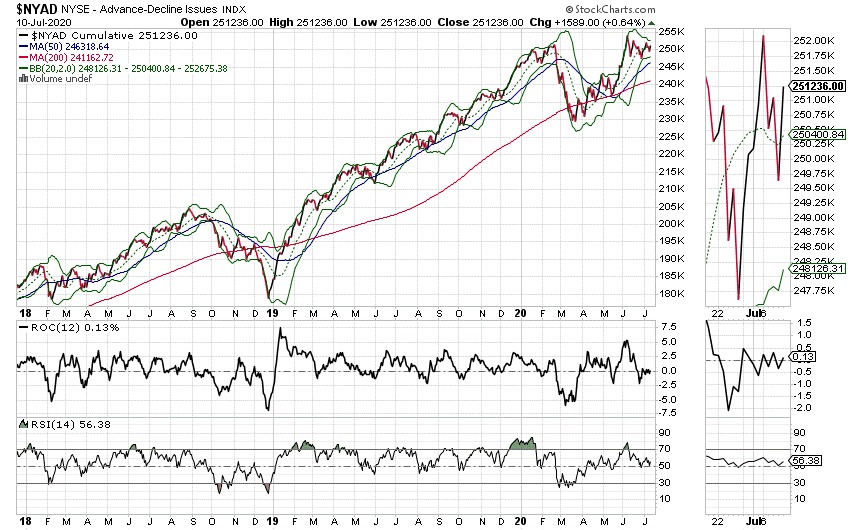
Perhaps the most interesting aspect of NYAD this week is the shrinking Bollinger Bands (green bands above and below the line). This is usually a sign that a big move in the market is coming.
Moreover, there are some technical clues that suggest that the move, when it materializes, may be to the upside. Of course, there are no guarantees as there is always the potential for headline risk and/or false starts.
Still, note that the most recent dip in NYAD held well above its previous low. Also note a similar occurrence in rate-of-change (ROC) and relative strength index (RSI). When you put these subtle chart findings in perspective, combined with the narrowing of the Bollinger Bands, they suggest that the odds favor an upside breakout as investors have been buying stocks during the consolidation (see SPX chart below).
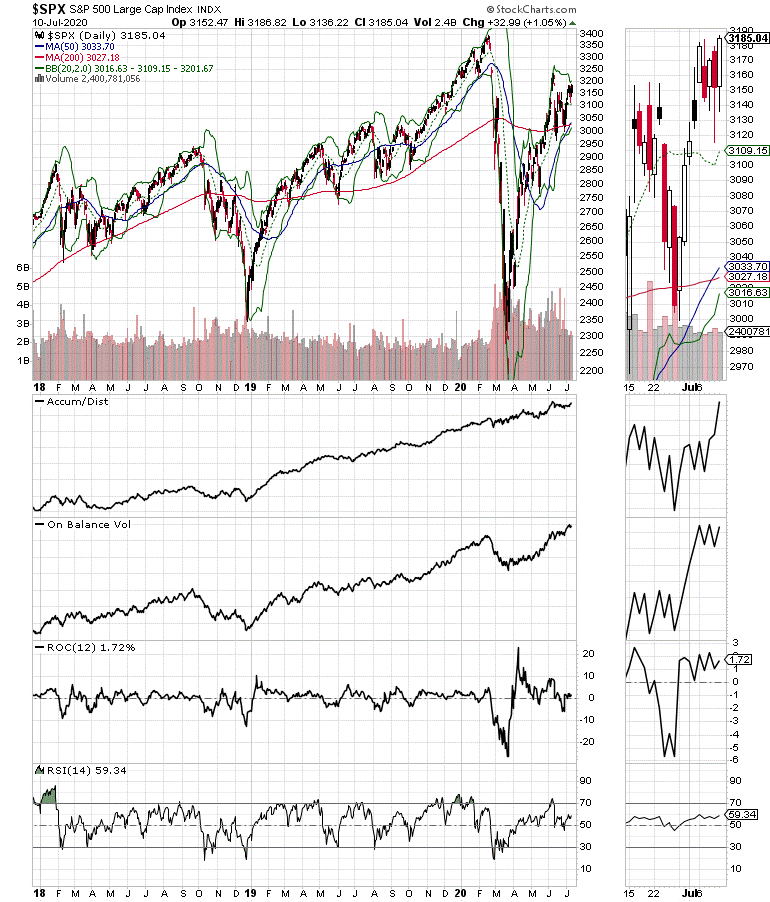
The S&P 500 (SPX) is mirroring the action on NYAD with an encouraging upturn in Accumulation Distribution (ADI) and On Balance Volume (OBV).
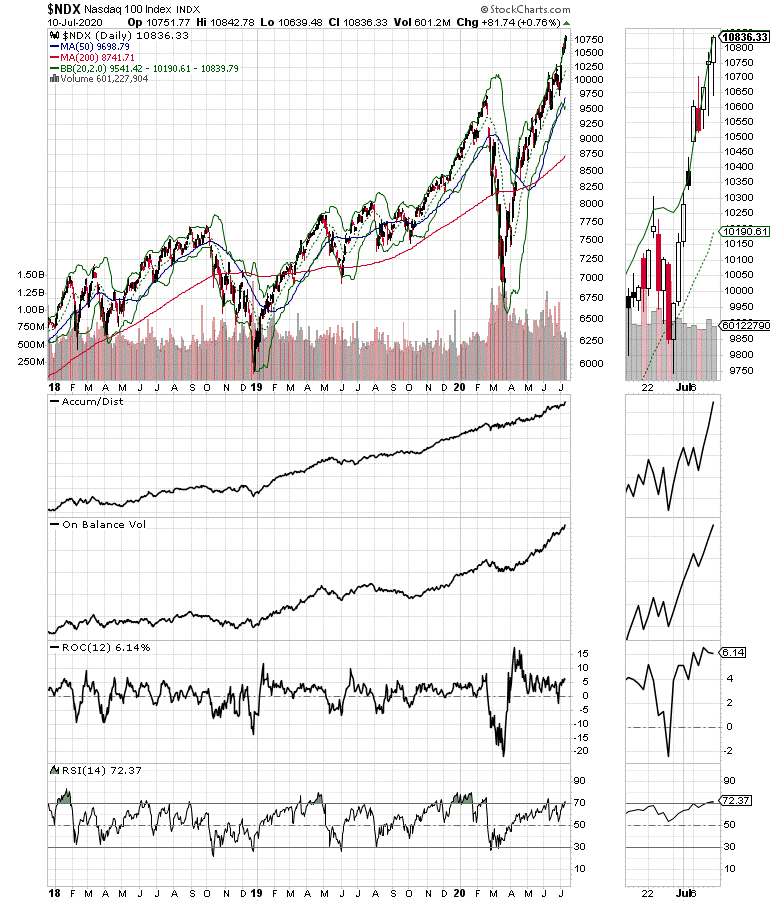
Meanwhile, the Nasdaq 100 (NDX) has been making new highs under heavy buying of tech stocks. NDX, however, is now becoming overbought. Also, the recent pullback in biotech and the consolidation in the semiconductors could put the brakes on NDX, at least in the short term (see chart below).
Without the Fed there is No Market
A big move in stocks is likely coming. There are technical clues that suggest that the move could be to the upside. But the fly in the soup is what the Fed does with its current QE initiative and whatever earnings season turns into.
Specifically, if the Fed pulls the plug on QE, especially if it does so in response to the perception that the market is doing well enough and that central bank liquidity is not necessary, they will be making a big mistake. In other words, regardless of the technical indicators, without the Fed, unless earnings are extraordinarily good, which is doubtful, there is little reason to own stocks at current valuation levels, especially with election volatility and the Covid-19 cases rising.
Stay tuned.
I own shares in GILD.
Joe Duarte is author of Trading Options for Dummies, and The Everything Guide to Investing in your 20s & 30s at Amazon. To receive Joe’s exclusive stock, option, and ETF recommendations, in your mailbox every week visit here. I’ll have more for subscribers in this week’s Portfolio Summary. For a 30-day Free trial subscription go here. For more direction on managing the GILD trade, go here. For more on these portfolio management techniques and stock picks that work consider a FREE trial to Joe Duarte in the Money Options.com by clicking here.