
What’s ailing the BDCs? The abbreviation stands for Business Development Companies, specialized lenders whose stocks are popular for the generous income they pay out. Lately, they can’t seem to get out of their own way.
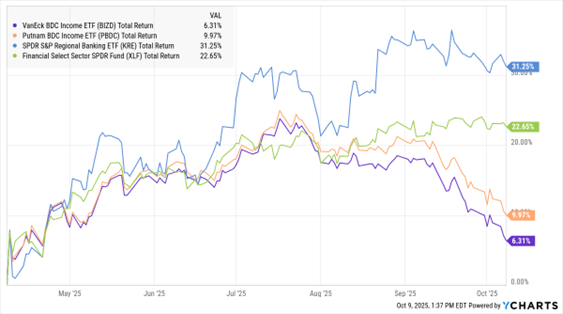
Take a look at the MoneyShow Chart of the Day. It shows how two benchmark BDC funds – the VanEck BDC Income ETF (BIZD) and Putnam BDC Income ETF (PBDC) – have performed over the last six months. It also includes the six-month percentage change in the SPDR S&P Regional Banking ETF (KRE) and Financial Select Sector SPDR Fund (XLF).
BDCs Sliding Even as Banks, Financials Rise
Data by YCharts
If you’re a long-time reader – or have seen my presentations at live MoneyShows – then you know I pay VERY close attention to credit markets. Subtle problems there can sometimes snowball into problems for the markets and economy as a whole. That's why I find this action interesting.
BDCs make mostly floating-rate loans. Because rates on those loans rise and fall with the federal funds rate, you could argue that recent Fed cuts are behind the weakness. All else being equal, Fed cuts will lower the rates BDC borrowers pay, ultimately lowering the payouts investors earn on BDC shares.
But in THIS environment, BDCs are also seen as a proxy for “private credit” risk. Lending activity fueled by investors, BDCs, and private credit funds has surged as traditional banks have stepped back. BDC assets jumped 33% year-over-year to around $500 billion in Q2 2025, according to JPMorgan. A separate Federal Reserve study found US private credit assets soared 5X to $1.34 trillion between 2009 and 2024.
Some observers (and yes, short-sellers) think private lenders have been too aggressive when it comes to taking on risk. They expect defaults to rise – and the recent decline in BDC shares could reflect those worries.
For now, we’re not seeing broader spillover into the banking sector. But I’d definitely keep an eye on this emerging development. If we see credit risk proxies continue to sell off – and credit spreads start to rise – it’ll be a signal to position more defensively.