
The record of geopolitical conflicts is clear: Markets can and WILL get past them...eventually. But the road between Point A to Point B can be volatile and financially treacherous. So, what’s moving now – and what might happen NEXT?
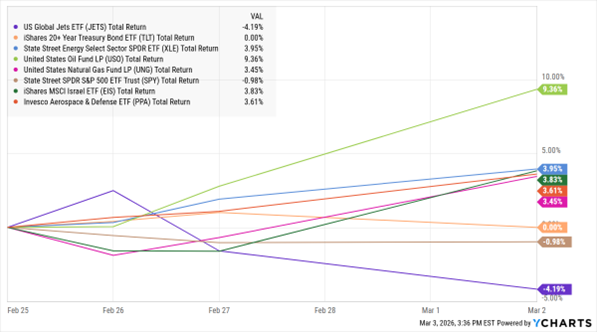
Let’s start with my MoneyShow Chart of the Day. It shows the performance of several ETFs over the past five trading days. They include ones that track key stock market sectors, like the US Global JETS ETF (JETS) and Invesco Aerospace & Defense ETF (PPA), and funds that track commodities, including the United States Oil Fund (USO) and United States Natural Gas Fund (UNG).
From Oil Prices to Airline Stocks, this Conflict is Hitting Home
Data by YCharts
The short-term impacts are abundantly clear – and in many cases, logical. USO up more than 9%, PPA up 3.6%, and JETS down 4% “make sense” given the threat to energy supplies, the likelihood of increased defense spending, and the large disruptions to global travel.
In other cases, they seem odd. The iShares MSCI Israel ETF (EIS), for instance, is up 3.8% despite the fact the nation is facing Iranian counterattacks. Then you have the iShares 20+ Year Treasury Bond ETF (TLT) unchanged. Treasuries have historically seen big “flight to safety” flows during global conflicts. But that isn’t happening this time around – likely because of fears higher energy prices will push already simmering inflation higher.
Which of these moves will stick for more than a few days? And how should you trade them? It all comes down to several questions, including…
- How long will the conflict last?
- What will the endgame be?
- Which energy facilities and supply routes will be targeted or disrupted?
- How will that impact oil, gas, and product prices…as well as inflation?
- How will monetary policymakers and businesses react – both here in the US and abroad?
As a long-term INVESTOR, you can take heart from one thing. No matter the conflict. No matter the result. Markets ultimately found their footing after fights both large and small. So, before you make large-scale, big-picture strategy shifts, try to keep that in mind.