

On Oct. 5, the Nasdaq Composite closed at a record 27,477.31 – and on the same day, 206 Nasdaq-listed stocks made new 52-week lows against only 46 that made new highs. The index is not diverging from the economy. It is diverging from the price of money, advises Michael Gayed, editor of The Lead-Lag Report.
A record index and a four-to-one ratio of lows to highs can coexist because indexes are weighted by size, and the biggest companies are not the ones paying the price of higher rates. The Russell 2000 was recently down 8.6% from its mid-August peak, while the SPDR S&P 500 ETF (SPY) was sitting within a fraction of a percent of its high.
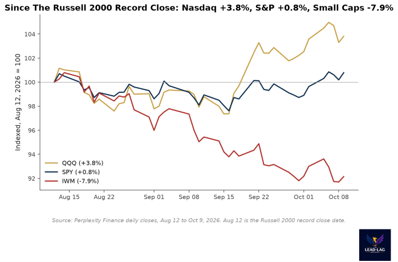
The gap between those two numbers is the story of the quarter. It is also, I would argue, a cleaner message than most of what the market has said all year: The problem is not growth. It is the cost of capital.
Year-to-date, the Russell 2000 is up around 13.1%. That figure is worth sitting with, because it hides the direction of travel. A small-cap index up 13.1% for the year does not look like a market in trouble. But it was up more than that two months ago.
Using the ETF that tracks it, the iShares Russell 2000 Index Fund (IWM) peaked at $305.09 on Aug. 14 and closed at $278.94 on Oct. 9, a decline of 8.6%. Over the same stretch, SPY was flat to slightly up. The performance is a story of the last eight weeks, not the last nine months.
In terms of leadership, the market has narrowed. It has not collapsed, it has narrowed, and narrowing is a different kind of fragility.