
About Sam
Sam's Articles


ENERGY

TRADING

TECHNICAL ANALYSIS

STOCKS
Sam's Videos

The S&P 500 recorded a “three-peat” in 2025, or three successive years of double-digit gains. What is the likelihood of scoring a “four peat?” Even though CFRA thinks the bull will remain intact by year-end, it projects increased volatility along with a lower-than-average full-year percentage increase. Why so cautious? Still-high valuations, an elevated Buffett Indicator, a softening jobs market, late-cycle and defensive sector leadership, combined with mid-term elections that typically present formidable headwinds. Offsetting tailwinds include the fourth year of this bull market and double-digit earnings growth expectations, not only for 2026 but also for 2027. Sam Stovall, CFRA’s Chief Investment Strategist, will discuss what the market’s recent rotation implies for investor returns in the year ahead.
STOCKS
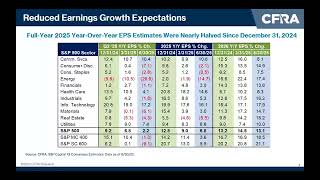
Investors are becoming increasingly fearful of a rising wall of worry that may trigger a new decline in the equity markets. Specifically, the S&P 500 gained more than 26% from the recent April low through late July, while undergoing a near-halving of 2025 EPS growth projections that pushed the S&P 500’s P/E on forward EPS to a level that exceeds more than two standard deviations above the 20-year mean. In addition, from a contrarian perspective, investors point out that the CNN Fear/Greed Index recently registered “Extreme Greed,” even though adverse effects from tariffs on inflation and earnings have been delayed but certainly not eliminated. Finally, the equity market is approaching the most challenging seasonal period of the year (August through October). Is it time to buy or bail? In this presentation, Sam Stovall, chief investment strategist at CFRA Research, will discuss CFRA’s forecast for the remainder of the year, justify his 6,580 year-end 2025 target for the S&P 500, and share typically encouraging equity returns during the fourth year of bull markets since WWII.
STOCKS
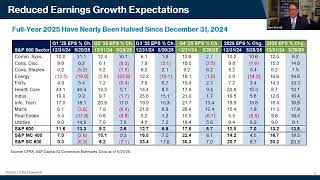
Investors continue to face stiff headwinds in 2025. Bull markets since WWII that went on to celebrate their third birthday posted gains averaging only 5%. The average drawdown for Republican presidents in their inaugural year was more than 15%. Nearly two-thirds of all bear markets since WWII started with double-digit declines that recovered to within -2% and +3.4% of the 200D MA before reversing and setting an even lower low. Are tariffs still headline rhetoric or recession-inducing realities? S&P 500 EPS growth for all of 2025 was pegged at nearly 13% at the start of the year. As of mid-May, that forecast was closer to 7%. Finally, 2024 was the sixth year in the past eight years when the tech sector rose by 30% or more in price. In this presentation, Sam Stovall, Chief Investment Strategist at CFRA Research, will discuss CFRA’s forecast for a full-year gain in price for the S&P 500 and show cautious investors how a portfolio consisting of only two sectors delivered 95% of Tech’s return since 1990 with 40% lower volatility.
STOCKS

The S&P 500 posted its second consecutive 20%+ annual advance. Yet since WWII, only 20% of the time did the S&P 500 follow up with a “three-peat.” What’s more, 2024 was the sixth year in the past eight in which the Tech sector rose by 30% or more. With that in mind, should investors buy last year’s winners or losers? A “Free Lunch” is defined as receiving something for nothing, or with investing, receiving a higher return with lower volatility. In this presentation, Sam Stovall, Chief Investment Strategist at CFRA Research, will discuss whether history advises buying last year’s winners or losers and how a portfolio consisting of only two sectors delivered 94% of Tech’s return since 1990 with 40% lower volatility.
STOCKS
Upcoming Appearances


Sam's Books
Seven Rules of Wall Street Crash-Tested Investment Strategies That Beat the Market by Stovall, Sam
Standard & Poor's Sector Investing: How to Buy The Right Stock in The Right Industry at The Right Time