Stocks mounted a relief rally Monday in the wake of the sharp pullback in the back half of last week. Fundamentals have marginally deteriorated since July, as we saw negative shifts on tariffs and the economy. But despite the slightly negative shift, the S&P 500 Index (^SPX) actually rose over the past month, observes Tom Essaye, president of the Sevens Report.
This reflects the fact that stocks 1) have still priced in a lot of continued future positives and 2) are still vulnerable to disappointment on multiple fronts.
(Editor’s Note: Tom is speaking at our Real Estate Plays for Profit and Income Expo, scheduled for Aug. 19-20, 2025. Click HERE to register for a FREE pass.)
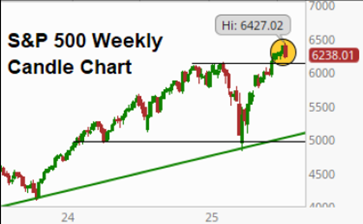
What’s changed? The most important influences on this market. For the past few months, the “TACO” principle (the idea that tariffs won’t be as bad as feared) was the main influence on markets. But that changed last week as the very soft jobs report brought economic growth back to the top of important market influences.
As we have consistently said throughout 2025, economic growth is, by far, the most important medium-term market influence. If recession fears rise, the stock market will drop sharply (easily more than 10%) regardless of Federal Reserve rate cuts.
To that point, Fed rate cuts have now become the second-most important influence on the markets. In the near term, investors are going to want to see the Fed fulfill very dovish expectations and confirm, as much as they can, that a rate cut is coming in September.
Finally, the previously most important market influence, TACO, is now third in importance for a simple reason: TACO has been proven at least partially false. With reciprocal tariffs announced and trade “deals” struck with most major trading partners, the reality is that most firms expect aggregate tariff rates to settle between 15%-20%.
That is solidly higher than the previous 10%-15%, and it increases the risk of stagflation. But it will also provide some semblance of stability in trade going forward.