When most investors hear “swaps in ETFs,” they immediately think of leveraged products. But firms like Calamos Investments are using swaps in ways that have little to do with leverage, writes Tony Dong, lead ETF analyst at ETF Central.
Rather than owning underlying securities, leveraged ETFs hold collateral and enter into agreements with a counterparty that commits to delivering the daily performance of the benchmark, net of fees. The structure resets daily, which makes it effective for short-term trading but problematic for long-term holding due to compounding effects.
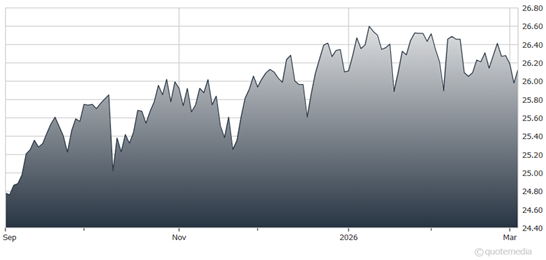
Calamos Autocallable Income ETF (CAIE)
That association has overshadowed the broader role swaps can play inside an ETF. Leverage is only one application. Swaps can also be used to solve structural problems that are difficult or inefficient to address with physical holdings alone.
Take the Calamos Autocallable Income ETF (CAIE). Since debuting in June 2025, the fund has grown quickly to about $693 million in assets under management, which speaks to investor interest in its structure.
Most of the portfolio is held in US Treasury bills. Those Treasuries serve as collateral for a total return swap linked to the MERQUBE US Large Cap Vault Advantage Autocallable Index. Under the swap, CAIE pays a rate based on SOFR plus 10 basis points to JPMorgan Chase as the counterparty.
This structure addresses several challenges that have historically limited access to autocallables. These instruments are structured products, typically available only through private placements, and they are operationally difficult to hold inside an ETF. Using a swap keeps the structure clean, scalable, and operationally viable.
The referenced index is a laddered composite of 61 live autocallable notes tied to US large-cap equities. At present, all of those positions are paying coupons, with a weighted average coupon rate of 14%. None of the positions are currently near maturity with principal at risk.
The laddered design matters. One of the primary risks with autocallables is timing risk, where outcomes depend heavily on when a note is issued and when it matures relative to market conditions. By spreading exposure across many notes with staggered start dates and maturities, the index reduces reliance on any single issuance.
That diversification helps smooth income, limit concentration in unfavorable market windows, and make the overall payoff profile more consistent over time. Distributions are also delivered in a more tax-efficient manner (largely return-of-capital) than holding individual structured notes directly.