
Historically, the semiconductor industry has been notoriously cyclical. Today, the AI boom has created an extraordinary imbalance between chip demand and supply, fueling surging semiconductor prices, revenues, earnings, and stock prices alike, observes Ed Yardeni, editor of Yardeni QuickTakes.
When chip demand outpaces supply, shortages boost prices. Higher prices, in turn, slow demand. High prices boost profit margins and stimulate manufacturers to expand capacity. As demand moderates and new supply comes online, pricing power weakens, and earnings growth slows or even turns negative. In other words, the best cure for high chip prices is high chip prices.
(Editor’s Note: Ed will be speaking at the 2026 MoneyShow Masters Symposium Sarasota, scheduled for Nov. 30 – Dec. 2. Click HERE to register.)
Source: Yardeni Research
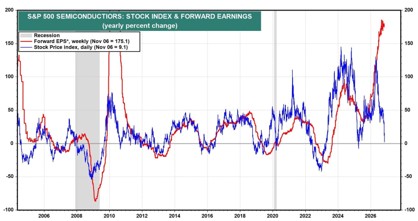
But a key divergence has emerged recently. Forward earnings growth for the companies in the S&P 500 Semiconductors industry has soared to 175% year-over-year, while gains in the industry's stock index plummeted from 130% YOY earlier this year to 9%.
Historically, the YOY percent change in the semiconductor stock price index has tended to peak before earnings growth peaked and bottom before it recovered. The latest divergence suggests that investors may already be anticipating a peak in earnings growth.
We think investors may be partially right: Demand for chips should continue rising as the AI revolution drives ever-greater demand for computing power. That should propel earnings growth. However, financial, political, and physical constraints are creating speed bumps for the AI investment boom, which should moderate the pace of growth in both chip demand and earnings.
Yet even after the S&P 500 Semiconductors stock price index plunged roughly 27% from its recent peak through Nov. 6, falling below its 200-day moving average, its uptrend remains intact in our opinion. Or stated another way, the semiconductor industry remains cyclical, but with a very bullish long-term trend. Accordingly, we view the latest selloff as a buying opportunity.