Stocks slid, while gold and crude oil soared, after the US and Israel launched widespread strikes on Iran. The US dollar spiked, while Treasuries sold off modestly.
Over the weekend, President Trump ordered missile, fighter, and bomber strikes on a wide range of Iranian targets. Israel joined the attacks, which killed Iran’s Supreme Leader Ayatollah Ali Khamenei and several other military and political leaders. Iran responded by launching hundreds of missile and drone attacks at virtually every country in the Middle East, many of which host US military bases or personnel.
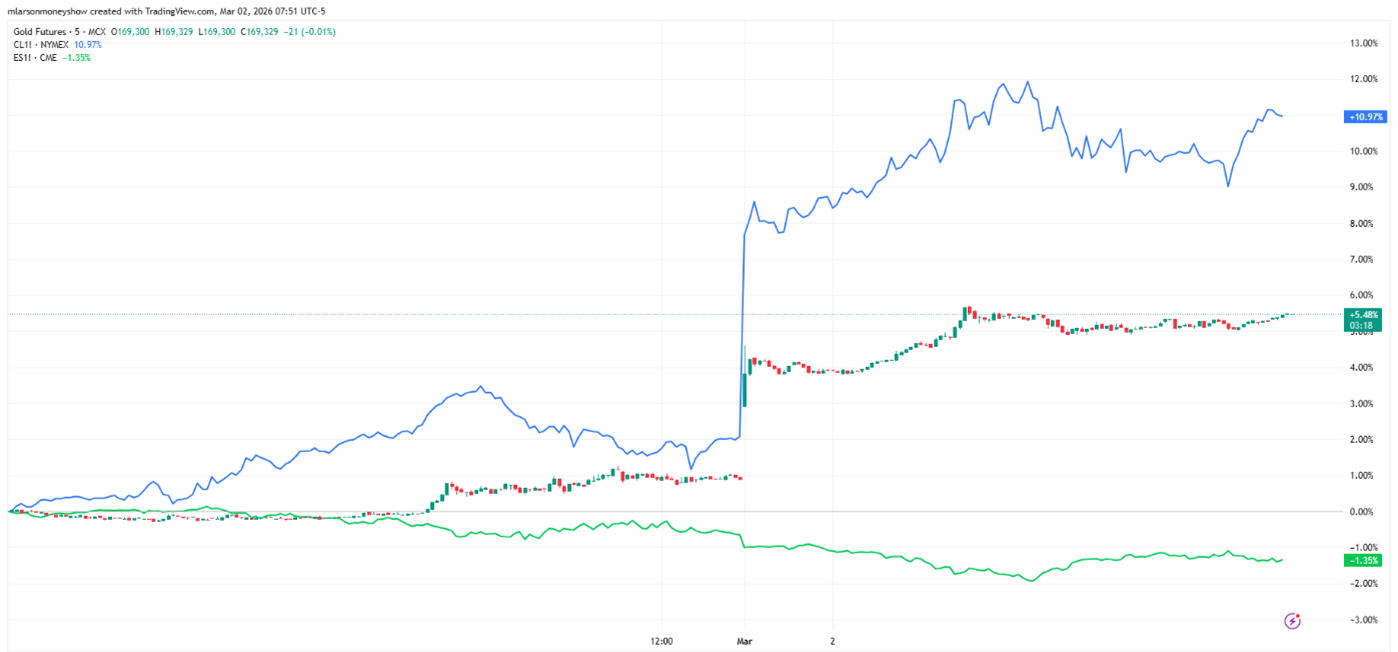
Gold, Crude Oil, S&P 500 E-mini Futures (1-Day % Change)
Source: TradingView
Gold was recently up around $152 an ounce to $5,400, while crude oil was up 8% to $72.51 a barrel. US natural gas prices rose around 5%, while European nat gas surged 28%. The continent relies on imports of Liquefied Natural Gas from the Persian Gulf, which are being disrupted by the conflict.
Shippers are largely avoiding the Gulf due to fears they will come under attack even as Iran has not (yet) vowed to shut the Strait of Hormuz to maritime traffic. Iran supplies roughly 5% of the world’s oil, and economists estimate a prolonged conflict could send prices up 20%. Still, the US is more insulated from surging oil prices than in past wars given the boost in domestic oil production over the past several years.
Inflation and economic risks tied to the Middle East conflict could exacerbate problems in credit markets, though. Risk spreads were already widening out due to worries about private credit and AI-driven disruption in a wide range of industries. Now, they’re rising further as investors unload riskier bonds. The extra yield on investment grade corporate bonds over and above the yield on US Treasuries just rose the most since last April’s Liberation Day market selloff.