
Markets are subdued in early trading, with stocks flat, oil down, and gold up. Treasuries and the dollar are recouping some ground they lost recently.
The US and Canada failed to reach a trade deal late last week, prompting the Trump Administration to slap tariffs of up to 50% on $20 billion of imports from Canada. Canada pledged retaliatory tariffs on a “dollar for dollar” basis, effective Sept. 8.
Vehicle tariffs were reportedly a key sticking point. Through last Friday, the Canadian S&P/TSX Composite Index (^TSX:CA) was slightly outperforming the US S&P 500 Index (^SPX) - up 14.9% vs. 12.1%.
TSX (Red), S&P 500 (Blue) – YTD % Change
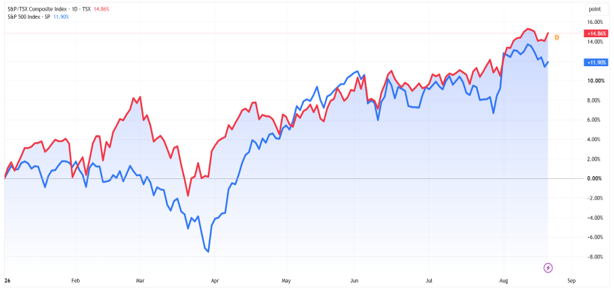
Source: TradingView
In other news, semiconductor giant Nvidia Corp. (NVDA) will report earnings on Wednesday - at a time when the “AI Trade” is evolving. Chip and hyperscaler stocks have gotten more volatile this summer as AI spending tallies rise and ROI questions grow.
Analysts expect adjusted earnings to roughly double in the fiscal second quarter to $2.09. Revenue is anticipated to rise 97% to around $92 billion. Nvidia stock has risen 15.1% year-to-date.
The other potentially big market-moving event this week will be in Wyoming. Federal Reserve Chairman Kevin Warsh will speak Friday at the Fed’s annual gathering of economists and policymakers in Jackson Hole. His highly anticipated speech comes amid spiking government bond yields - and largely unsuccessful efforts by Treasury Secretary Scott Bessent to tamp them down.
Finally, Chinese e-commerce giant Alibaba Group Holding Ltd. (BABA) shook up Asian markets after announcing plans to sell $10.2 billion in additional shares in Hong Kong to fund AI-related investments. The secondary offering of 710 million shares added to those aforementioned concerns about AI capex costs. Alibaba’s US-traded shares are down 19% YTD.