For decades, the intellectual elite of high finance has dismissed gold as a non-productive hunk of yellow metal that serves no purpose in a digitized, high-speed economy. But in 2026, the narrative is starting to wear thin. At its recent price of roughly $5,060 per ounce – and using the SPDR Gold Shares (GLD) as a proxy – there are a couple of stark observations, notes Bryan Perry, editor of Cash Machine.
First, the veneer of “King Dollar” is showing gaping cracks due to a $38+ trillion US federal deficit that is soaring like a firehose with no cutoff value. Gold isn’t just a hedge. It’s becoming the only remaining exit ramp from a global experiment in fiscal recklessness.
Second, the most compelling case for gold today isn’t found in jewelry stores, but in the halls of central banks. Since the 2022 freeze of Russian reserves, the world has learned a chilling lesson: your money in a foreign bank is actually a permission slip. Especially if it sits in a Swiss bank.
Nations in the Global South and the BRICS+ bloc are no longer content holding IOUs from a US Treasury that can be canceled with a keystroke. This isn’t just a de-dollarization theory anymore; it’s a massive, structural reallocation of capital.
SPDR Gold Shares (GLD)
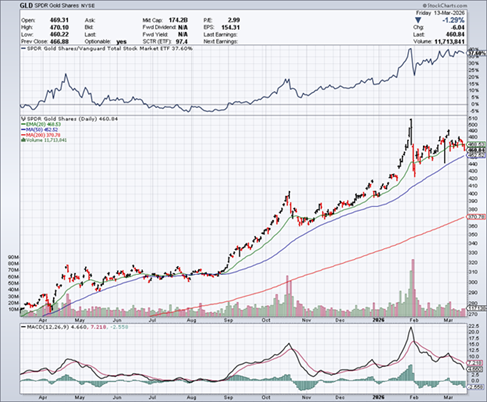
Meanwhile, even as the price of gold has exploded higher, it has done so on a massive rise in volume and huge bullish money flow. This isn’t just hedging. This is preparing for a trap-door, black swan financial crisis.
As of March 11, the total US national debt is sitting at approximately $38.8 trillion. To put the speed of this growth into perspective, we are currently adding about $7.2 billion per day.
The G7’s combined sovereign debt is roughly $65 trillion today – with not a single fiscal policy mandate in place to address rising debt and reduced spending. When this race to the bottom for debt-laden fiat currencies culminates, it will not end well. Next stop for gold — $6,000 an ounce.