I’ve been doing a lot of reading, listening, and watching over the past three weeks. And I can confidently say that...no one knows where things are headed in the next couple of weeks and months, advises Sam Ro, editor of Tker.co.
Federal Reserve Chair Jerome Powell was asked recently how higher energy prices from the conflict in Iran would affect the economy. His answer: “The thing I really want to emphasize is that nobody knows…The economic effects could be bigger. They could be smaller. They could be much smaller or much bigger. We just don’t know.”
With the stock market, it’s usually the case that people don’t know how prices will behave in the near term. But I think this is especially the case right now.
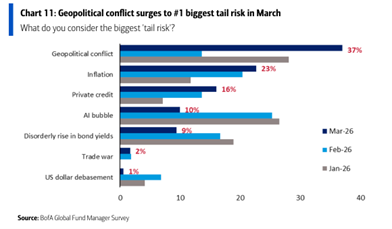
For starters, many market participants didn’t see the attack on Iran coming. According to BofA’s Global Fund Manager Survey, just 14% of market pros cited geopolitical conflict as their top “tail risk” in February. In March, that jumped to 37%.
The experts with the highest conviction in their forecasts seem to be commodities analysts who are convinced oil prices are headed higher. But even they struggle to understand why prices aren’t much higher already.
According to TKer Stock Market Truth No. 8: “The most destabilizing risks are the ones people aren’t talking about.” That’s because these risks aren’t priced into the market. And when they materialize, traders and investors inevitably scramble to price them in, often with incomplete information. The added uncertainty alone is enough to drive prices lower.
From a markets perspective, I think we’ll know the worst is behind us only far in hindsight. This doesn’t mean prices necessarily go much lower from here. It’s certainly possible that the stock market has bottomed in anticipation of some de-escalation in the future. It is typically the behavior of the stock market to bottom before everything else.
But I don’t know.