The iShares Defense Industrials Active ETF (IDEF) is a relatively new ETF. By comparison, the iShares US Aerospace & Defense ETF (ITA) is a much more established option. For those considering either fund, here’s how IDEF stacks up against ITA in a head-to-head look, notes Tony Dong, lead ETF analyst at ETF Central.
Despite already gathering about $3.2 billion in AUM, IDEF only launched on May 19, 2025. ITA debuted in May 2006 and currently holds about $13.5 billion in AUM. For many investors, ITA would likely be the more obvious choice given its longer track record and scale.
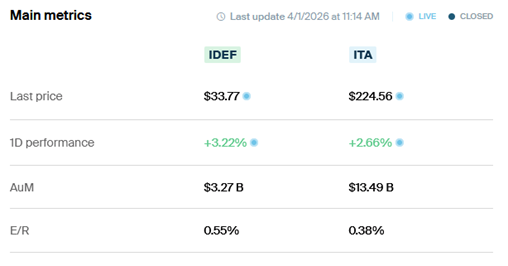
But let’s talk methodology. The ITA tracks the Dow Jones US Select Aerospace & Defense Index. In practice, that results in a relatively narrow portfolio, market-cap weighted and selected based on having significant revenue tied to aerospace or defense activities. The methodology is clearly defined, and you can dig into index documents, backtests, and supporting research to understand exactly what is driving performance.
IDEF is far more opaque. It is actively managed by Simon Wen, Yasmin Messner, and Lucy Parker, and like most active strategies, it functions more like a black box. The mandate is broadly defined around capturing companies that may benefit from increased government defense spending and geopolitical fragmentation, but there is less clarity on how positions are selected or weighted.
Looking at the portfolio helps fill in the gaps. ITA is almost entirely US-focused, while IDEF is more globally diversified, with the US making up just under 60% of the portfolio and meaningful exposure to markets like the UK and South Korea.
Both ETFs are heavily tilted toward industrials, which is expected, given the nature of defense contractors. However, IDEF extends beyond traditional defense names into adjacent sectors like information technology, materials, and energy.
On a year-to-date and trailing three-month basis, IDEF has outperformed ITA by a meaningful margin. In plain terms, this is what investors would call alpha. The portfolio managers’ security selection and weighting decisions have, at least so far, translated into a clear performance advantage.
Verdict: Over the short-to-intermediate term, IDEF has delivered higher returns with similar or even slightly lower risk. That is the hallmark of successful active management, where security selection and portfolio construction add value beyond a passive benchmark, even after accounting for higher fees and potential style drift over time.