Data centers have been everywhere in the headlines lately. The themes driving that attention go beyond just AI demand. Exposure is now available in ETF form through the Global X Data Center REITs & Digital Infrastructure ETF (DTCR) and the Pacer Data & Infrastructure Real Estate ETF (SRVR), notes Tony Dong, lead ETF analyst at ETF Central.
Most AI investors gravitate toward chipmakers or software companies building large language models. But Real Estate Investment Trusts (REITs) that own and lease out data centers effectively operate like tollbooths, collecting rent from hyperscalers and cloud providers that need the infrastructure to run.
Both DTCR and SRVR are passive index trackers. But the benchmarks they follow take very different approaches for security selection and weighting.
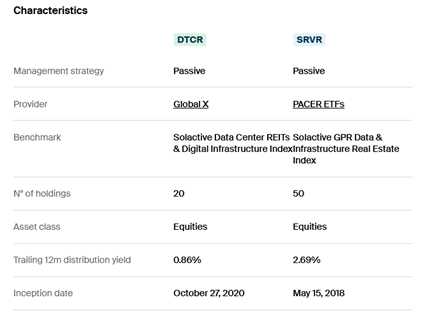
DTCR tracks the Solactive Data Center REITs & Digital Infrastructure Index. It’s a relatively concentrated portfolio of just 20 holdings, with a 0.8% trailing 12-month yield. The strategy goes beyond traditional real estate by including companies tied to the broader data center ecosystem. That means you’re not just getting landlords, but also exposure to semiconductor names that support the buildout.
SRVR, on the other hand, tracks the S&P Global Data & Infrastructure Real Estate Index, with a broader basket of about 50 holdings. It also offers a higher 2.6% 30-day SEC yield. The focus here is more squarely on real assets, with greater weight in real estate and some exposure to communications.
Both funds are top-heavy, but DTCR is more concentrated. Its top 15 holdings account for 84.8% of the portfolio, compared to 72.6% for SRVR.
Over the trailing five-, three-, and one-year periods, as well as year-to-date, DTCR has outperformed SRVR. By stepping outside of real estate and into technology, it has benefited from the strength in semiconductors and AI-related infrastructure, while REITs have faced pressure from higher rates.
That positioning has also made DTCR the more popular fund, with consistent net inflows over the same periods. SRVR, in contrast, has seen net outflows despite its larger and more established portfolio.