AI investors aren't just targeting large language model developers, hyperscalers, or semiconductor manufacturers anymore. We've moved into individual links within the AI value chain itself. But what about the unloved parts of the market? One ETF worth examining is the iShares FinTech Active ETF (BPAY), writes Tony Dong, lead ETF analyst at ETF Central.
To find unloved funds, I turned to ETF Central's segment screening tool. It currently tracks 107 ETF categories. I was looking for categories that exhibited one or both of the following characteristics: poor trailing performance and significant investor outflows.
Poor performance by itself does not necessarily create opportunity. Sometimes an ETF category is falling because fundamentals are deteriorating. Likewise, outflows alone do not automatically make an investment attractive. Investors can be selling for perfectly rational reasons.
iShares FinTech Active ETF (BPAY)
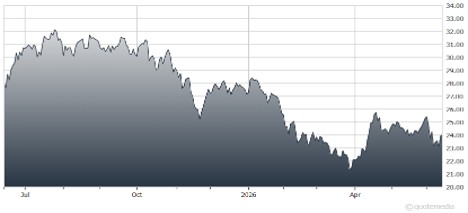
However, when entire themes become broadly disliked, it often creates situations where sentiment becomes disconnected from fundamentals. One ETF segment that immediately jumped out at me was fintech.
As of June 1, the five ETFs within the segment had collectively delivered an average one-year loss of 13.8%. Investors have not exactly been rushing in to buy the dip either. The category has experienced roughly $122 million in net outflows over the same period and, altogether, the segment only accounts for about $413 million in assets under management.
BPAY was launched in August 2022. The fund has struggled to gather assets and currently sits at roughly $9.1 million in AUM. The ETF charges a 0.55% net expense ratio and holds approximately 40 stocks.
The portfolio leans heavily toward consumer-facing fintech businesses. Buy now, pay later providers feature prominently. There is also meaningful exposure to brokerage and trading platforms. One aspect I find interesting is that the active mandate allows the managers to venture beyond traditional financial stocks.
The portfolio includes companies such as Sea Ltd. (SE) and MercadoLibre Inc. (MELI), both of which have built substantial fintech ecosystems alongside their e-commerce operations. That flexibility creates a broader view of financial technology than simply owning payment processors.