
The largest indexed ETFs are going to vary in their SpaceX (SPCX) exposure, following the stock’s IPO completed on June 12. Nasdaq and FTSE Russell decided to fast-track the inclusion of mega-cap IPOs in their indices, while S&P DJI opted not to change its methodology, explains Aniket Ullal, VP, ETF Data & Analytics at CFRA Research.
The iShares Russell 1000 ETF (IWB) and Invesco QQQ Trust (QQQ) are expected to hold SPCX starting on June 29 and July 7, respectively. In contrast, the iShares Core S&P 500 ETF (IVV) and State Street Communication Services Select Sector SPDR Fund (XLC) will not include SPCX until mid-2027 at the earliest. ETFs with the most significant SPCX exposure post-IPO are specialized thematic ETFs, such as space-themed ETFs.
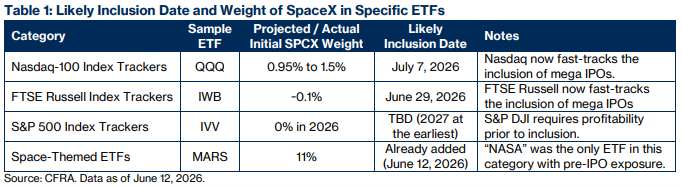
SPCX has listed Class A and unlisted Class B shares. Both are used to determine its total market capitalization for index eligibility, qualifying it for fast-track entry into the Nasdaq-100. For most stocks, total listed market cap is used to determine weights in the Nasdaq-100. However, for companies like SPCX with a very low float count, index shares are capped at three times the number of free float shares.
Given this index share count, SPCX’s weight in QQQ will likely be 0.95%-1.5% depending on the share price. SPCX has a staggered expiration schedule for locked-in shares held by insiders, so we expect its index weight to increase over time as more shares become free-float eligible.
We estimate that asset managers would need to buy approximately 8% of SPCX’s float shares after its addition to the Nasdaq-100. There is an additional $130 billion in non-leveraged ETF assets in the US linked to the Russell 1000 and Russell 3000.
However, since these indices are float-adjusted, the weight of SPCX is projected to be very low (around 0.1%). Asset managers would need to buy less than 0.2% of SPCX’s float shares after the addition of the stock to these indices.