
Is the massive and growing investment in AI infrastructure worth it? It’s a loaded question that yields different answers — depending on who you ask. But investors should remember that big investments don’t hit income statements all at once during a single reporting period, advises Sam Ro, editor of Tker.co.
One of the sloppier answers to the AI infrastructure question goes something like this: “Every quarter, mega-cap tech companies announce new huge investments in AI. But even after spending all that money, they’ve been reporting huge quarterly profits.”
This view isn’t technically wrong, but it obfuscates how companies account for the investments in their financial statements. While it is true that companies are spending massive amounts of cash on AI (as reported on cash flow statements), the bulk of these investments have yet to appear as accrued expenses on future income statements.
And it’s the income statement that gives us the quarterly earnings we hear about in the news every three months. It’s how we get a better sense of a company’s ongoing profitability.
This is a wonkier topic than what I usually write about. But I suspect it’ll become increasingly important to understand as these expenses become a bigger part of quarterly earnings announcements.
You see, companies depreciate big investments over their estimated useful life, which usually lasts years. That means the hundreds of billions of dollars spent on AI infrastructure will effectively be chopped up and spread out over years. And that means we’ll see much more of it show up in the form of ballooning depreciation expenses in future quarterly earnings reports.
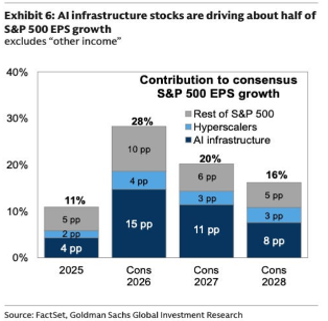
Goldman Sachs’ Ben Snider ran the numbers and cautions that the coming depreciation expense will be a major hurdle for earnings growth:
“Hyperscaler depreciation expenses will continue to increase as capex growth decelerates, further dampening the boost of AI investment spending to S&P 500 earnings growth…We estimate a drag from hyperscaler depreciation expenses on S&P 500 earnings growth of 5 pp in 2027, offsetting nearly half of the 11 pp boost to earnings from capex spending. By 2028, the drag from depreciation should offset the S&P 500 earnings uplift from continued capex spending.”
In other words, Snider expects the AI earnings tailwind to fade by 2028 as depreciation expense becomes a bigger headwind.