
Somewhere between the regional bank scare and the AI rally, financial commentary settled on a fixed piece of folklore: The American consumer is cracking. But the surprise risk in consumer credit for the next year runs toward resilience, suggests Michael Gayed, editor of The Lead-Lag Report.
The idea was that consumers were financed by credit cards at 21% interest, and the crack was a matter of time. The call was not crazy. Card delinquencies rose for 11 straight quarters through 2023 and 2024 – and peaked at 3.22%, the highest since 2011, in the spring of 2024.
The problem is what happened next, because almost nobody updated the story. That peak was more than two years ago, and the rate has now fallen five consecutive quarters to 2.85%. The consumer recession everyone braced for arrived...and it ended, quietly...while the consensus kept preparing for it.
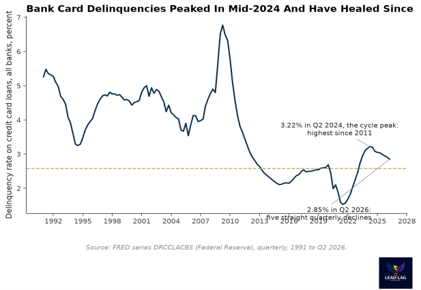
The shape of the series matters as much as the level. Commercial bank card delinquencies climbed from a cyclical trough near 2.1% in 2021 to that 3.22% peak in mid-2024, a textbook two-year deterioration that filled conference agendas with K-shaped consumer panels.
Then the series rolled over: 3.20 in Q3 2024, 3.08 in Q4, 3.05, 3.04, 2.99, 2.95, and 2.91 by the first quarter of 2026, before reaching 2.85% in the second. Five straight quarterly declines, each one small, each one in the same direction.
Delinquency data is the definition of a lagging indicator, which is exactly why it is worth respecting when it turns. By the time it moves, the underlying stress has already peaked and started to drain.
The honest case against this piece is real, and I want to state it fully. A 2.85% delinquency rate is still above the 2019 average of 2.59%, so this is healing, not health. The New York Fed's flow measures remain far above pre-pandemic norms, which means the subprime tail is still visibly stressed.
But overall, the positioning implication is about staleness. Consumer-stress positioning, whether expressed through credit-sensitive equities, defensive allocation, or simply the refusal to own anything with a household in the business description, has been priced against a deterioration that stopped in mid-2024.