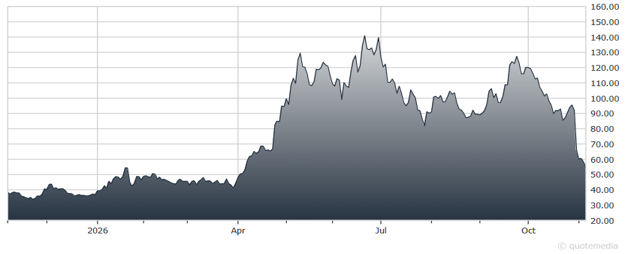
Intel Corp.'s (INTC) nearly 29% stock collapse following its third-quarter earnings illustrates the central problem confronting the company's turnaround. A key problem is Intel’s biggest customer: itself, writes George Gilder, chief analyst at Gilder’s Technology Report.
Intel continues to demonstrate substantial technological capabilities, including advanced packaging, leading-edge semiconductor manufacturing, and increasingly competitive data center processors. But these capabilities have not translated into sustained profitability at Intel Foundry.
(Editor’s Note: George will be speaking at the 2027 MoneyShow/TradersEXPO Las Vegas, scheduled for Feb. 21-24. Click HERE to register.)
Intel Corp. (INTC)
Consider: The company reported $6.7 billion in quarterly foundry revenue...but approximately 94% comes from internal manufacturing transactions rather than independent customers. Intel Foundry continues to generate substantial operating losses, raising questions about when its manufacturing investments will produce acceptable financial returns.
Against this backdrop, Intel's announced acquisition of quantum software developer Classiq introduces a potentially important new dimension to its manufacturing strategy. The reported $2.3 billion transaction would move Intel beyond its decade-long quantum research program into commercial quantum software, processor manufacturing, and potentially integrated computing systems.
Intel's quantum strategy deserves attention because it builds upon manufacturing capabilities that the company has developed over several decades. The Classiq acquisition adds a commercially oriented software platform to Intel's silicon spin-qubit research, control electronics, and fabrication expertise. More importantly, hardware-independent software gives Intel an opportunity to participate in quantum computing growth even if competing architectures achieve greater commercial success than its own processors.
But the investment case ultimately depends on whether Intel can achieve what has remained elusive throughout its foundry transformation: Translating manufacturing leadership into profitable growth.