Stocks tumbled across the board yesterday, but they’re trying to stage a modest rebound this morning. Gold and silver are bouncing after a vicious selloff, while Treasuries and the dollar are flattish.
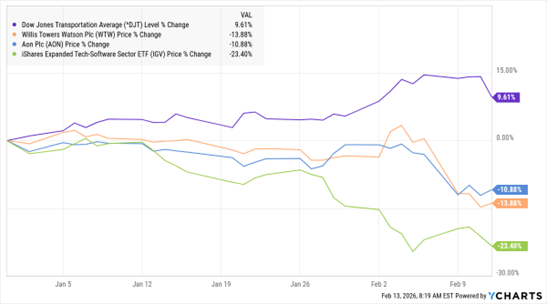
The “AI Disruption” trade spread like wildfire this week, with the latest sector to get smacked being transportation stocks. The Dow Jones Transportation Average sank more than 4% on Thursday, its biggest one-day drop since the “Liberation Day” turmoil in early 2025. Ironically, the catalyst appeared to be a press release about an Artificial Intelligence-fueled “SemiCab” tool for freight companies from a small Florida company that used to make karaoke machines.
Dow Transports, WTW, AON, IGV (YTD % Change)
Data by YCharts
That followed Monday’s wipeout in shares of insurance brokerages like Willis Towers Watson Plc (WTW) and Aon Plc (AON). Those stocks tumbled on news that OpenAI had approved an AI insurance app allowing ChatGPT users to get home insurance quotes on the platform. And that, in turn, followed other declines in financial services and SaaS stocks – all driven by fears that AI will disrupt their business models and crimp future profit growth. The iShares Expanded Tech-Software Sector ETF (IGV) is now down 23.4% year-to-date.
On the economic front, the Consumer Price Index rose 0.2% on the headline and 0.3% on the core in January. The former undershot economist estimates, while the latter was in line with them. Inflation is settling into the mid-2% range on a year-over-year basis. That’s not as cool as the Federal Reserve would like it, but not as hot as it was a couple years ago. That should encourage the Fed to sit on its hands for a while, rather than cut interest rates further at its next couple of meetings.
Meanwhile, the “Sell America” trade has morphed into a “Hedge America” move, according to the Wall Street Journal. Foreign investors own $36 trillion in US assets like stocks and bonds - and the ongoing slide in the dollar threatens their value. The ICE US Dollar Index (^DXY) has dropped 10.1% in the last year.
But they’re still attracted to the growth prospects of large US corporations. Plus, they have to invest here given US dominance of global economic activity and benchmark indices. So, they’re hedging currency risk via derivatives and trimming bond holdings around the edges rather than drastically dumping assets.