Energy prices started the morning out tame - but are on the move now. Equities and gold are sliding along with Treasuries, while the dollar is modestly higher.
The Middle East war remains squarely in focus, with more tit-for-tat attacks and Israeli assassinations of key Iranian targets overnight. Crude oil was mostly stable earlier, but is now climbing after Israel attacked Iran's South Pars oil and gas facilities - and Iran promised to retaliate.
Meanwhile, Wall Street is also closely watching the Federal Reserve. It’s wrapping up its latest policy meeting...and it’ll likely be a divisive one. While the Fed won’t cut rates, we could see three dissenting votes in favor of a reduction. That would be the first time there has been so much “on the record” squabbling since 1988.
For what it’s worth, 1-month Treasury Bill Yields have actually climbed about 10 basis points so far this year to 3.7%. The current federal funds rate target range is 3.5% - 3.75% -- and the chance of it still being there as of December has spiked sharply since the US-Israel-Iran conflict broke out. Worth noting: The Producer Price Index for February rose 0.7% on the headline and 0.5% on the core – both hotter readings than economists expected.
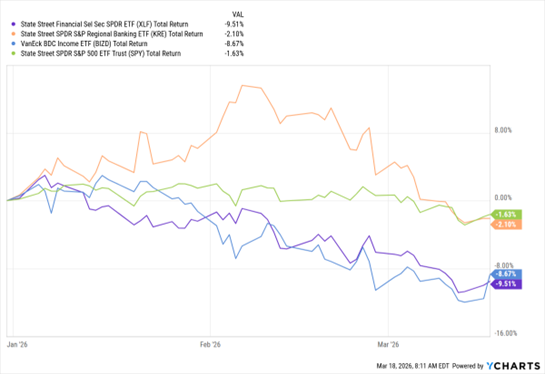
XLF, KRE, BIZD, SPY (YTD % Change)
Data by YCharts
In other news, the $1.8 trillion private credit market continues to get a lot of coverage on and off Wall Street – with some experts warning of a massive and painful unwinding and others downplaying the risk. Lotfi Karoui of Pacific Investment Management Co. forecast a “deep rethinking on how much illiquid risk” investors are willing to take on as more loans sour and funds choose to fulfill only a portion of the redemption requests they’re getting.
Meanwhile, former New York Fed President Bill Dudley wrote on Bloomberg that the private credit situation doesn’t measure up to the subprime lending debacle and Great Financial Crisis of 2007-2008. He argued that bad loan writedowns to date have been linked to fraud by the borrowing companies, not systemic lending problems. He also highlighted differences in funding structures in the industry versus those that helped worsen the mortgage crisis.
Regardless, financial stocks continue to perform poorly amid previous default worries PLUS concerns over credit strains tied to higher energy prices. While the State Street SPDR S&P 500 ETF (SPY) is down 1.6% year-to-date, the State Street Financial Select Sector SPDR ETF (XLF) is off 9.5%. Funds that track regional banks and Business Development Companies (BDCs) are also underperforming the market.