Stocks are sagging amid rising war fears. Crude oil is higher, while gold and silver are mixed. Treasuries and the dollar are flat.
President Trump’s 8 pm Eastern deadline is rapidly approaching – with no sign Iran will agree to terms the US has specified. That could lead to widespread strikes on Iranian power plants and bridges, triggering counterattacks on allied infrastructure sites in the Middle East. Israel is already reportedly attacking railways and other infrastructure in Iran.
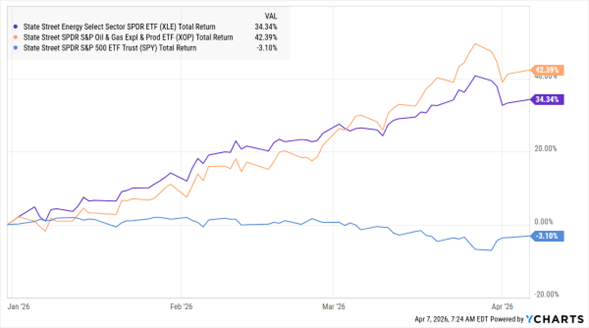
XLE, XOP, SPY (YTD % Change)
Data by YCharts
As always, oil prices are the best barometer for measuring market sentiment over the war. US WTI futures were recently trading around $115, while Brent crude was going for $111. The US benchmark’s spike peak from March 8 was around $119 – so we’re getting close to fresh highs.
Rising energy prices have left the State Street Energy Select Sector SPDR ETF (XLE) sitting on 34.3% gains year-to-date. The State Street SPDR S&P Oil & Gas Exploration & Production ETF (XOP) is up 42.3%. By contrast, the State Street SPDR S&P 500 ETF Trust (SPY) is down 3.1%.
In other news, the billionaire activist investor Bill Ackman is trying to acquire Universal Music Group NV in a transaction worth as much as $64.7 billion. Ackman’s Pershing Square Capital Management owns 4.5% of UMG, and is pushing to merge Universal with his US-based investment firm. UMG was listed in Amsterdam as part of a spinoff from the Vivendi media conglomerate in 2021. It’s the world’s largest music company, with artists like Taylor Swift and Drake in its roster.
Lastly, the “fire sale” is on in US office property markets. Owners and lenders are accepting cut-rate offers on buildings in various US cities, rather than continuing to hold out for higher prices. One Chicago building that sold a decade ago for $68.1 million just changed hands for $4 million, according to the Wall Street Journal. Another $176 million Denver property sold for $5.3 million in foreclosure. Elevated interest rates and the post-Covid work-from-home trend have driven US office property values down about 35% nationwide, according to research firm Green Street.