
Stocks staged a solid intraday rally yesterday, though they’re subdued in the early going today. Ditto for Treasuries. Crude oil is dipping a bit along with the US dollar, while gold and silver are rising.
The parade of earnings from “Big Finance” is continuing today, with JPMorgan Chase & Co. (JPM) reporting Q1 earnings of $16.5 billion, or $5.94 per share. That topped estimates for $5.43 in EPS. Capital markets-focused businesses performed exceptionally well, with investment banking fees surging 28% and trading revenue rising 20%.
JPM, WFC (YTD % Change)
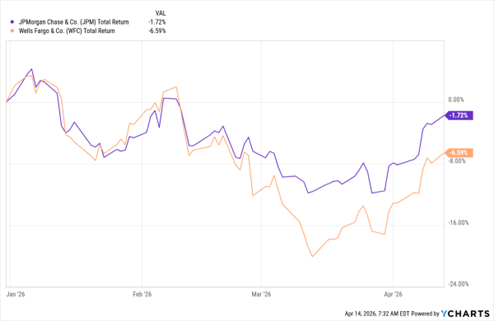
Data by YCharts
Still, Chase stock has stagnated in 2026 amid broader credit concerns. CEO Jamie Dimon’s warning of an “increasingly complex set of risks” is keeping a lid on JPM shares today, too. Meanwhile, competitor Wells Fargo & Co. (WFC) delivered modestly disappointing net interest and noninterest income – while also reporting a 22% rise in loan-loss provisions.
Everyone knows oil and gas prices are higher because of the Middle East conflict. But the enormous divergence between futures and spot market prices is a story that hasn’t gotten as much notice. Both WTI and Brent futures prices slid during the day yesterday, settling under $100 a barrel. But physical oil buyers are paying more than $130 to secure barrels in the shorter term for reasons this Wall Street Journal story covers.
Meanwhile, the Strait of Hormuz blockade that President Trump just implemented could drive up global demand for US-produced oil and LNG. The tracking firm Kpler says roughly 70 Very Large Crude Carriers (VLCCs) are headed to Gulf Coast export facilities – up from an average of 27 per month in 2025. That’s good news for US producers and their shareholders. But if more domestic production gets diverted to foreign markets, it could drive US product prices (think gasoline) higher.
Lastly, Bloomberg is reporting that United Airlines Holdings Inc. (UAL) has considered linking up with American Airlines Group Inc. (AAL). If the two companies were to combine, it would create the largest airline on the planet – with $100 billion-plus in annual revenue and more than 2,800 airplanes. Given enormous antitrust concerns, however, any proposed deal would face significant headwinds.