
“The collapse in Venezuela is not a surprise as we predicted this would happen many years ago,” writes Phil Flynn, Senior Energy Analyst The PRICE Futures Group.
Both crude oil prices and Venezuela are backing down as Venezuelan President in question Nicolas Maduro thought it best to hold off on demanding that U.S. diplomats leave the country after the Trump administration warned of a “significant response” if American personnel are threatened or intimidated.
The second thoughts of that action by Maduro probably granted him a little time before the United States buries the Venezuelan economy by imposing sanctions on their oil exports. This comes as the oil markets worry about what the Federal Reserve might do as well as new concerns about the health of the Chinese economy as Chinese and U.S. negotiators meet in Washington on Wednesday. Still according to Reuters, the price of crude oil has risen by 12¢ so far in January, the largest increase in percentage terms in the first month of the year since 2005, when it rose by 14¢.
The collapse in Venezuela is not a surprise as we predicted this would happen many years ago. The years long movement towards socialism, a system that has ultimately failed everywhere it has been tried, has pushed the Venezuelan economy near collapse. The United States are full of people who fled to this country to escape the evils of socialism. There are ways to improve capitalism but not by selling the dignity of the individual and their right to life, liberty and pursuit of happiness for the power of the state to decide if their rights are in their best interests.
Trade negotiations in China are on Wednesday. Bloomberg reports that President Donald Trump and China’s Xi Jinping gave their officials until March 1 to work out a deal on “structural changes” to China’s economic model. If they fail, President Trump has promised to raise the tariff rate on $200 billion in Chinese imports to 25% from 10%. The collapse of talks would dash hopes of a lasting truce that would remove one of the darkest clouds hanging over the world economy. Vice Premier Liu He will meet U.S. Trade Representative Robert Lighthizer in Washington for two days of talks starting Wednesday. They’ll build on discussions that have focused on everything from how many American soybeans China buys to the subsidies Beijing gives its state-owned companies.
“While the announcement of a final deal isn’t expected this week, there’s a good chance negotiations will produce a package of proposals to present to both presidents,” said William Reinsch, a former Commerce official during the Clinton administration.
For crude oil, the deal is big because some fear that a slowdown in China will hurt global oil demand. Reuters reported that crude fell 1% on Monday after U.S. companies added rigs for the first time this year, a signal that crude output may rise further, but the price is still on course for its strongest gain in the month of January for 14 years (see chart). Much of the demand outlook hinges on China and whether or not its refiners will continue to import crude at 2018’s breakneck pace. Industrial companies in China reported a second monthly fall in earnings in December, despite the government’s efforts to support borrowing and investment.
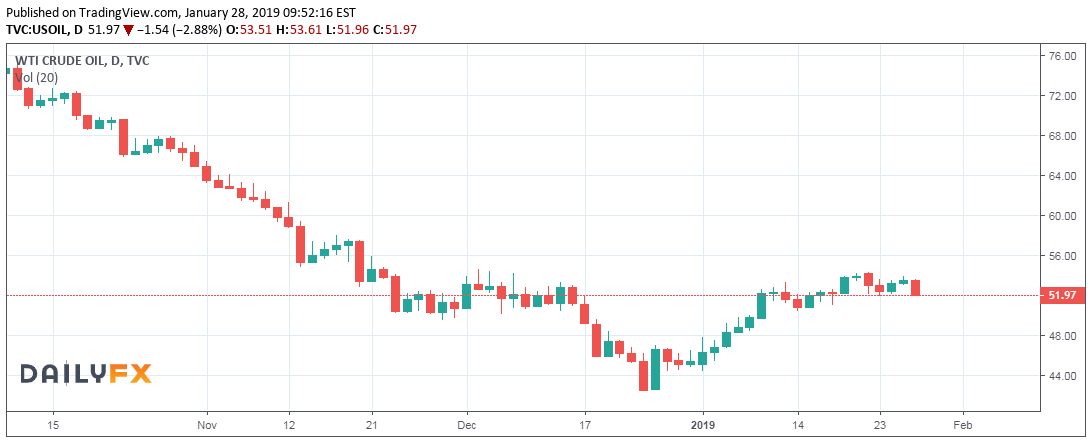
Some are pointing to the first rig count increase this year as one of the reasons that oil is feeling early pressure. The Baker Hughes rig count showed that the U.S. rig count increased by 9 rigs to 1,059 last week, which was a nice bounce after last week’s decline of 25 rigs. Oil rigs +10 to 862. Gas rigs -1 to 197.
Natural gas got hit hard as the weather forecast for the Northeast warmed up! Maybe spring will come after all.