

The bears are so close they can taste it, but they’re not quite there.
Anyone reading this from Cleveland? Just a couple of years ago the Cleveland Indians took the Cubs to extra innings in game 7 of the World Series. Once the game went into extra innings, anything could happen. You can actually say you survived through 7 regulation games and they should declare a split title. Alas, there is no such thing. You either win it or you don’t. You either get there or not. It either happens or it doesn’t.
Last week, markets came to the seasonal change point (Spring Equinox), which in this case just so happens to be the new calendar year for the Gann cycle. It also corresponded with the most recent Federal Reserve Open Markets Committee (FOMC) meeting. As we know, the Fed came out dovish. At first markets went up, then they came down. Then they went up again but risk was increasing. By the end of the week risk was very high as markets got hit on Friday. They followed through on Monday as well. That led us to a very interesting but tricky condition. Monday was the 61-day window off the bottom (see chart below). Nobody gets a free pass in the market. On the one hand we did get a turn on the seasonal change point. But how many times have we seen it invert and a couple of days later turn right back the other way?
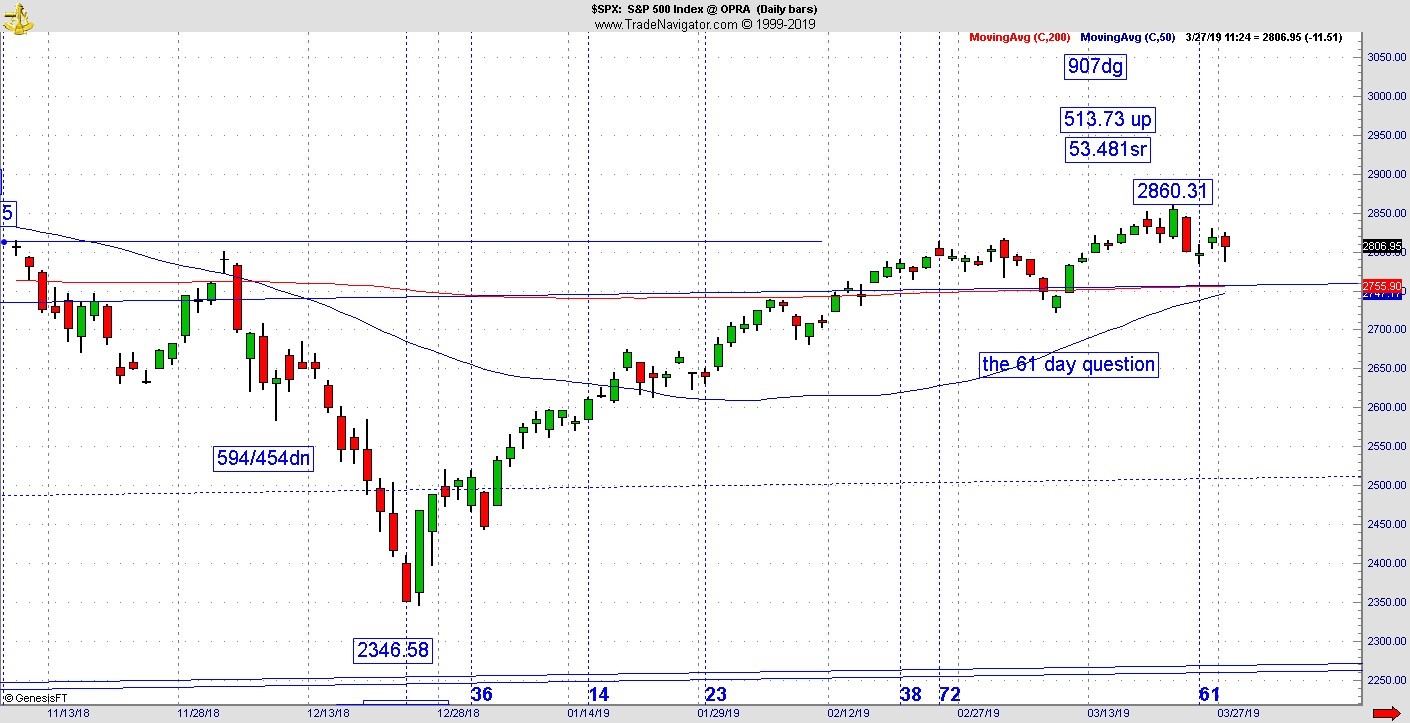
This may or may not happen but one has to be aware of it. I’m certain at least a few of you who watched game 7 of that epic 2016 World Series also have watched poker on television. You would know if a player has four to a flush, he has to calculate the odds or ‘outs’ he has in order to pull his hand. Let’s say you have four to a flush on diamonds. From what you can tell, nine diamonds have been played. That means there are four of 13 diamonds left in the deck. That means you have a 4/13 chance or a 30% chance of pulling your hand. You have four outs left.
Using that logic, on Monday night, I figured the bulls had one ‘out’ left in order to save the rally. Markets were starting to roll over and in the case of the Russell 2000 and Dow Jones Index, the calculations for a top were already in place. Now the rest of the market was starting to react. We learned the yield curve was inverting, which suggests a recession could be on the way.
We’ve already endured a three-month bear phase. By the end of Monday, the SPX was sitting at the 61-day window and had to almost immediately turn back up or else it could be over. In my mind, if we woke up on Tuesday and the Dow was down another 400, it was likely over. But that didn’t happen. Markets were up although they weakened later in the day. I don’t know the exact figure but let’s say the Dow was up around 260. Late in the session it was only up around 40. Had the market closed giving back those gains, the bears could almost claim victory. They were in extra innings and so close they could taste it. But the bulls caught a second wind and the Dow finished up 140. The bulls are still alive, but on the other side of the coin they could’ve been up 400 on the Dow but it didn’t happen.
That brings us to Wednesday where the bears hit them early but couldn’t hold on. Bulls are still alive. The bears have had them on the ropes since last Friday and can’t seem to finish them off. What would be a key indication they are finishing them off? If they start taking out the low from Monday, on the SPX 61 day, that would mean they are serious. Technically speaking, in terms of the cycles, they would invalidate any potential 61-day inversion. Unless something new were to materialize, the highest probability is the bears would then get the upper hand. What kind of upper hand? If the low on Monday were to be taken out in a meaningful way, the entire 2019 rally could be over. The stakes are high.
In terms of the bond market, the yield curve is starting to invert. That puts the crowd in a double jeopardy situation. Whichever way the bond market goes, its wrong. If prices go higher, rates go down which is an indication of lower demand for money. That means a weaker economy. If prices go down, meaning rates go up that could mean risk gets higher because of the rising cost to service debt. It becomes a case of heads I win, tails you lose.
Watch Monday’s low very carefully. The market could be rolling over as it has shown weakness. But let’s not forget that in a true bull phase, the pattern comes right to the ledge but never jumps. They are right there looking in the ditch.