

As the market closed the final chapter of 2025 and opened the first page of 2026, conditions softened. The SPDR S&P 500 ETF Trust (SPY) declined roughly 1% on the week. But the broader formation showed relative resilience, notes Buff Dormeier, chief technical analyst at Kingsview Partners.
Leadership retreated more sharply, with the Invesco QQQ Trust (QQQ) pulling back 1.7%. In contrast, the Invesco S&P 500 Equal Weight ETF (RSP) declined a more-modest 0.4%. The dividend-oriented brass commanders, represented by the Schwab US Dividend Equity ETF (SCHD), managed a small gain of approximately 0.3%. This dispersion suggests that investors favored balance and income as the calendar turned, rather than concentrated leadership exposure.
Invesco QQQ Trust (QQQ)
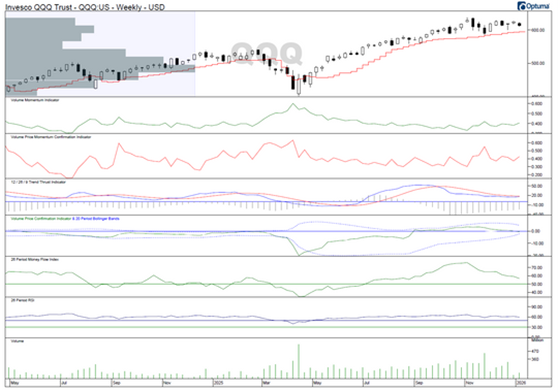
Volume conditions were notably subdued, even by short-week standards. Upside volume and capital inflows were particularly light, while Capital Weighted downside volume registered near average levels. The weakness occurred primarily within the year’s strongest performing units, consistent with late-year profit taking rather than broad-based liquidation. Overall, roughly 68% of total volume was weighted to the downside.
Market participation weakened meaningfully. After testing resistance the prior week, the accumulated NYSE Advance–Decline Line broke below the Dec. 12 wide range bar, though it continues to hold an upward intermediate trend. Leadership reflected similar behavior.
Taken together, the final two weeks of the year appear less like an orchestrated retreat but more like selective units being called back for year-end holiday leave. Participation has thinned, leadership has paused, and capital has grown cautious.
The true marching orders for 2026 are likely still forming behind the scenes and may not reveal themselves until liquidity and conviction return in the weeks ahead. Periods of transition often blur the line between signal and noise. While price weakness has emerged, the absence of aggressive volume and the resilience of defensive and equal-weight exposure suggest recalibration rather than new marching orders.