

Over the years, we’ve discussed a lot of volatility-based trades. Since volatility is high now, a number of them are apropos. The simplest is to buy call options on CBOE Volatility Index (^VIX) futures or on a volatility ETF, including the ProShares VIX Short-Term Futures ETF (VIXY) or 2x Long VIX Futures ETF (UVIX), explains Lawrence McMillan, editor of Option Strategist.
With the war in Iran still in an uncertain state, professional traders are worried. Those worries are expressed through increasing put-call ratios and an increase in volatility-related indices and products. Traders hedging stocks are buying equity puts, and that increases the equity-only put-call ratios.
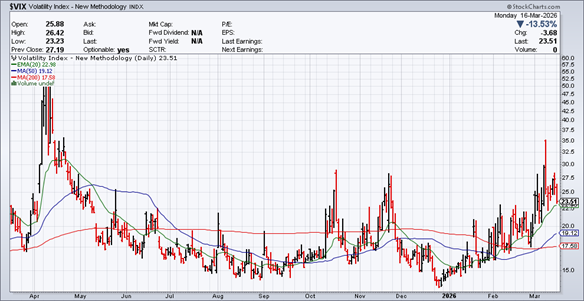
Meanwhile, traders worried about the broad market are buying puts on the S&P 500 Index (^SPX), which in turn translates to an increase in VIX and all of its related products: futures, options on those futures, and volatility ETFs and ETNs. These are increases in implied volatility, not necessarily realized volatility.
We have been talking about these increases for some time because they began last December. It’s not a new phenomenon. But now things are reaching a state where there are some opportunities arising for volatility traders to act.
The various products that can be traded are VIX futures, VIX mini futures, options on the VIX futures (traded at the CBOE), volatility ETFs and ETNs (which generally own VIX futures), and options on those ETFs and ETNs. If you think implied volatility is going to continue to increase – keeping in mind that VIX rose as high as 60 last year, 65 the year before, and 85 in 2020 – there are plenty of products to buy that rise along with implied volatility.